

Last autumn, during a hunting trip near Kugluktuk, Nunavut, Beau Taptuna and his family came across a peculiar sight. They discovered several dead caribou on the land, showing no signs of gunshot wounds. Taptuna suspected that the animals had succumbed to a parasite transmitted by insects. Concerns about the impact of insects on animals such as caribou and muskox have also been raised by other members of the community.
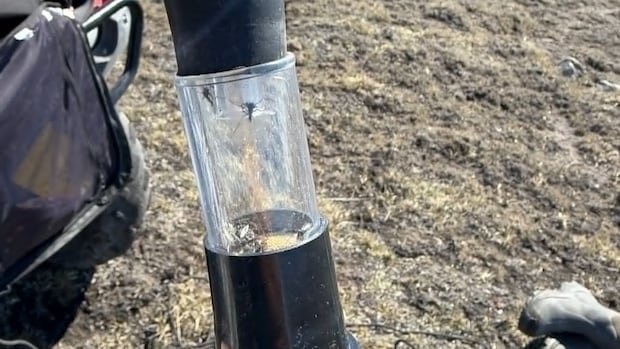
Taptuna, a summer science ranger in Kugluktuk, is actively involved in the Kitikmeot biting insect monitoring program. This program, supported by federal funding, focuses on studying insects, the parasites they carry, and their effects on animals. It also monitors the diversity of biting insects like black flies and mosquitoes in response to changing climate conditions. Initially launched in Kugluktuk three years ago, the program has since expanded to Gjoa Haven, Kugaaruk, and Cambridge Bay, Nunavut.
As part of his responsibilities, Taptuna employs various nets to capture insects for further analysis in laboratories at the University of Guelph and the University of Calgary.
In a recent development, Danielle Nowosad, a postdoctoral fellow at the University of Calgary, reported findings from the project indicating that insects are emerging earlier due to rising temperatures and a greater variety of insect species compared to a survey conducted in 2010-2011. Nowosad projects a potential increase in insect populations in the future, leading to a higher presence of mosquitoes and other biting insects on the land, possibly introducing new species.
Taptuna’s insect samples from the previous year in Kugluktuk revealed nearly 300 insect species. Nowosad’s research on species distribution models using climate data predicts a significant expansion in the geographical area where black flies can breed in the North in the coming decades.
The monitoring program was initiated following a request at a hunters and trappers organization’s annual general meeting in 2022. It is a community-driven initiative that emphasizes active engagement with community members, elders, and harvesters.
Hannah Zikalala, a project manager in Cambridge Bay, expressed her enthusiasm for participating in the program and conducting fieldwork. She highlighted the program’s importance in safeguarding the health and size of caribou populations in the North, emphasizing the potential threat of insect-borne parasites.
Nowosad emphasized the program’s focus on monitoring parasites, revealing a greater diversity in parasites than previously assumed through advanced genomic techniques. She also mentioned ongoing investigations into the possibility of new biting insects migrating northward due to wildfires in southern regions.
The program is set to continue for a few more years, with a research paper slated for release in the fall. Taptuna stressed the significance of the monitoring program beyond insect matters, emphasizing its critical role in preserving the animal life cycle, which is vital for the community’s sustenance.