

On Monday, Alberta activated the notwithstanding clause while presenting new legislation aimed at compelling striking teachers to return to work.
Here’s a brief overview of this infrequently utilized provision and its significance.
What does the notwithstanding clause entail?
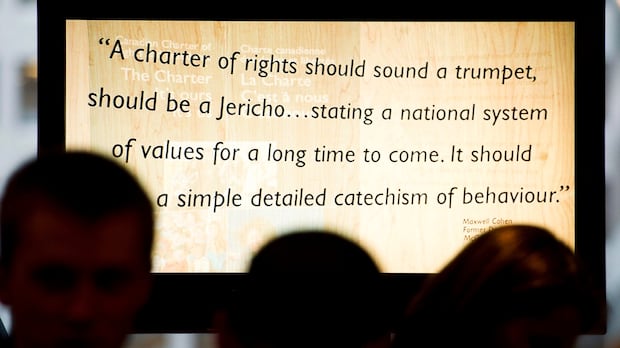
The notwithstanding clause is outlined in Section 33 of the Canadian Charter of Rights and Freedoms.
In essence, it permits either a federal or provincial legislature to enact laws that contravene specific constitutional rights and freedoms, “notwithstanding” the protections afforded by the Charter.
Which rights does it impact?
The invocation of Section 33 is limited to overriding sections 2 and 7 through 15. These sections encompass the “fundamental,” “legal,” and “equality” rights.
Included in these areas are crucial principles of the Charter, such as:
- freedom of expression
- freedom of religion
- freedom of association
- protection against unreasonable searches and seizures
- right to legal counsel and habeas corpus
- protection against cruel and unusual punishment
- protection from governmental discrimination
However, the notwithstanding clause does not apply to democratic rights, mobility rights, language rights, or the sexual equality clause.
Once invoked, the clause remains effective for five years. Since elections must occur at least once every five years, this allows the public to hold the invoking government accountable.
What is its purpose?
When Canada brought its constitution home from the United Kingdom in 1982, provincial leaders were reluctant to endorse the new Charter of Rights and Freedoms due to concerns about a potential transfer of power from legislatures to the judiciary.
The notwithstanding clause was proposed as a compromise by Peter Lougheed, who was Alberta’s premier at the time, to make the Charter more acceptable to the provinces and encourage their agreement.
How frequently has it been utilized?
Since its introduction in 1982, the provinces of Quebec, Ontario, Saskatchewan, Alberta, and Yukon have enacted laws invoking the notwithstanding clause.
Here are some recent instances:
- In 2000, Alberta invoked it to implement legislation against same-sex marriage.
- In 2019, Quebec employed it to ban the wearing of religious symbols by public employees in authority roles; this law (including the notwithstanding clause) was renewed for an additional five years in 2024.
- Saskatchewan used it in 2023 in relation to legislation on sexual education and requiring parental notification when students alter their name or pronouns.
Does the Charter guarantee a right to strike?
In 1987, the Supreme Court provided a reference opinion concerning an Alberta law that limited the right to strike, indicating that “freedom of association” was an individual right—implying that there was no constitutional right to strike.
This was overturned by a pivotal Supreme Court ruling in 2015, which affirmed that the Charter does indeed uphold a right to strike.
“The right of employees to strike is essential for safeguarding a meaningful process of collective bargaining,” stated Justice Rosalie Abella in the decision, Saskatchewan Federation of Labour vs. Saskatchewan.
According to Barry Eidlin, a sociology professor at McGill University, this ruling significantly changed workers’ rights in Canada.
“Before that 2015 ruling, legislatures frequently enacted back-to-work legislation,” he notes.
“In fact, Canada was somewhat unique in its tendency to legislate workers back to work.”
What are the repercussions if workers defy a back-to-work law?
The repercussions would vary based on the specifics of the law and its enforcement. However, Eidlin refers to a 2022 case as a useful example.
In that instance, Ontario Premier Doug Ford invoked the notwithstanding clause to enact legislation that prohibited education workers from striking.
The backlash was immediate. Surveys indicated that only 36 percent of Ontarians supported the decision. The education workers continued their strike regardless, and unions throughout the province threatened a general strike.
Within four days, Ford retreated. The law was swiftly retracted, and the education workers agreed to halt their strike and return to negotiations.
“This highlights that government actions are ultimately based on their perception as legitimate political entities,” Eidlin states. “When governments behave in ways seen as illegitimate, it is very likely that their actions will be disregarded.”