
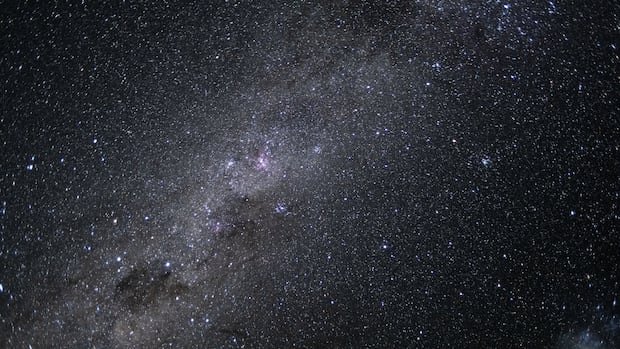

A recent breakthrough in scientific research has sparked discussions within the scientific community, shedding light on the potential origins of life on Earth. In a groundbreaking discovery, a team of scientists in Spain has detected sugar near the core of the Milky Way galaxy, located approximately 26,000 light-years away from Earth.
Using advanced radio telescopes, researchers at Spain’s Centre for Astrobiology identified a four-carbon sugar known as erythrulose within a molecular cloud. Erythrulose, commonly found in raspberries and utilized in self-tanning products, was found for the first time in the interstellar medium—a region comprising gas and dust existing between stars.
The significance of this finding lies in the fact that sugars played a crucial role in initiating life on Earth. The formation of sugar molecules has long been a mystery among scientists. Sarah Gallagher, the director of the Institute for Earth and Space Exploration at Western University, emphasized the importance of these basic building blocks in creating nucleic acids essential for life on our planet.
This discovery complements previous research, such as the identification of ribose and glucose sugars in samples from the asteroid Bennu. Scientists speculate that sugars may have been delivered to Earth through comets and asteroids during its early stages, but the exact source of these sugars has remained elusive.
Led by Izaskun Jiménez-Serra, the Spanish research team estimated that around 50 million tons of erythrulose could have reached Earth’s surface during the Late Heavy Bombardment period, approximately 4.1 to 3.8 billion years ago. Their study, published in the Nature Astronomy journal, suggests that the interstellar medium could serve as a potential source of sugar not only on Earth but also elsewhere in the universe.
This groundbreaking revelation opens up possibilities for further space exploration and the discovery of additional sugars and vital molecules crucial for the origins of life. It reinforces the notion that the materials necessary for RNA formation may have been present on early Earth, hinting at the potential role of comets and asteroids in delivering essential molecules to other celestial bodies.
Nagissa Mahmoudi, an associate professor at McGill University, views this discovery as a significant piece of the puzzle in understanding the early Earth’s environment and the potential for life beyond our planet. The findings support the notion that life could exist elsewhere in the universe, highlighting the universality of fundamental building blocks necessary for life as we know it.
This remarkable breakthrough not only deepens our understanding of the origins of life on Earth but also ignites curiosity about the existence of life beyond our planet.