


Suckerfish, also known as remoras, are not always the most courteous companions during their oceanic travels.
These small fish hitch rides by attaching themselves to larger marine creatures like sharks, whales, and manta rays, feeding on parasites in exchange for the transport.
While this arrangement seems mutually beneficial, recent studies suggest that having a remora alongside may pose challenges for manta rays.
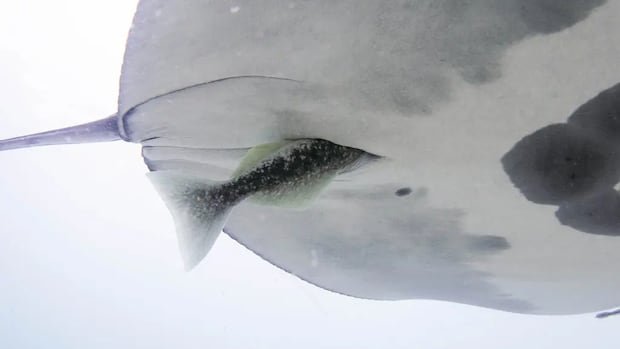
“These fish are inserting themselves into the cloacal openings of manta rays,” said marine researcher Emily Yeager from the University of Miami in an interview with As It Happens host Nil Kӧksal. “This could be quite discomforting for the rays.”
Yeager, a PhD candidate, is the primary author of a fresh report on this behavior, published recently in the journal Ecology and Evolution.
Referred to as ‘cloacal diving’
The act is termed “cloacal diving” as the fish enters the host’s cloaca, a combined orifice for reproduction and waste expulsion.
While cloacal diving has been observed between remoras and whale sharks, where the latter are considerably larger than rays, this interaction with rays is a novel discovery.
Researchers have documented seven instances across different oceanic regions over 15 years, suspecting it occurs more frequently than reported.
“This behavior might be underreported as often only the tail tip of the remora is visible protruding from the manta ray’s cloaca,” Yeager mentioned. “They really wedge themselves into that area.”
She believes this behavior is a response to fear in remoras. In a video, a diver startles a male Atlantic manta ray near Florida, causing a nearby remora to swiftly dive into the ray’s cloaca.
“The manta ray then reacts with strong shuddering before moving on,” she added.
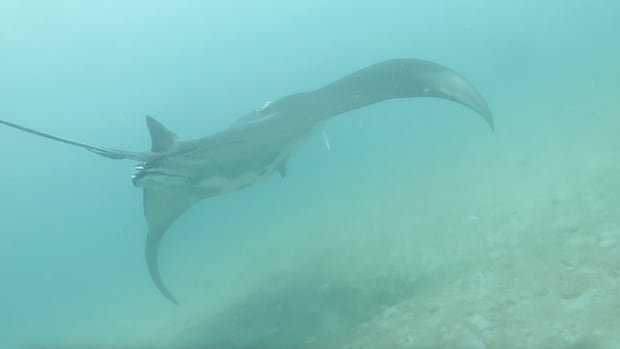
Remoras, also known as suckerfish, are well-known for hitching rides on large marine animals like sharks and manta