
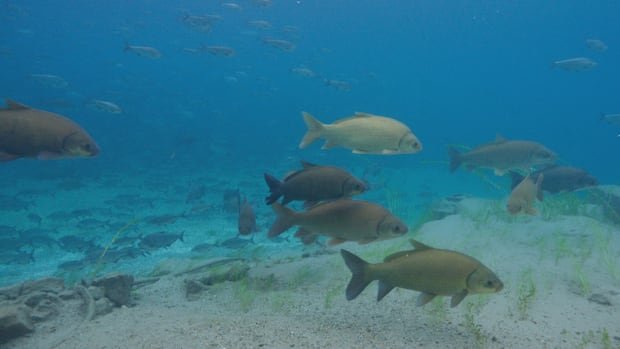

In Lake Huron, striking underwater visuals have showcased a vibrant area dubbed “fish city” by a documentary crew for Earth Day. However, the Saugeen Ojibway Nation (SON) disputes this characterization, labeling the warm-water outflow from the Bruce Nuclear Generating Station as a “fish trap.”
SON highlights a significant incident in 2025 where up to five million gizzard shad perished at the site, as documented by the Department of Fisheries and Oceans in a Canadian Nuclear Safety Commission report. This massive die-off resulted in the clogging of cooling water intake systems, prompting the utility to shut down Bruce A Unit 2.
Additionally, SON points out the plight of several lake sturgeon, an at-risk species culturally significant in Anishnaabe teachings, which became stranded in a pond at the plant. While one sturgeon was rescued in November, three remain in the forebay.
The dispute over the “fish city” narrative extends beyond mere visuals, raising concerns about how Bruce Power manages environmental risks as it seeks regulatory approval to enhance plant limits for increased electricity production.
Although the Bruce station releases warmer water into Lake Huron as part of its cooling system, leading to fish aggregation, regulators did not attribute the 2025 die-off to the plant. SON biologist Ryan Lauzon, who conducted a detailed study on the incident, describes the site’s operation as a two-stage process of attraction and entrapment, emphasizing the risks posed to fish.
Bruce Power refutes claims of causing the 2025 die-off, attributing it to unusual environmental conditions. The utility has implemented various measures, such as nets and monitoring systems, to prevent fish entrapment.
Seeking to boost electricity output by 11% by 2030 without constructing a new reactor, Bruce Power faces scrutiny from regulators. The company asserts that the proposed increase aligns with safety and environmental standards.
Despite operating under stringent regulations, Bruce Power’s 2024 report highlighted the absence of clear benchmarks for assessing fish losses due to plant operations, underscoring the ambiguity surrounding acceptable environmental risks.
The impact of the gizzard shad die-off goes beyond ecological implications, as it disrupts the lake ecosystem and cultural significance of fish for Indigenous communities. The event underscores the delicate balance between environmental preservation and energy production, emphasizing the need for sustainable practices.