
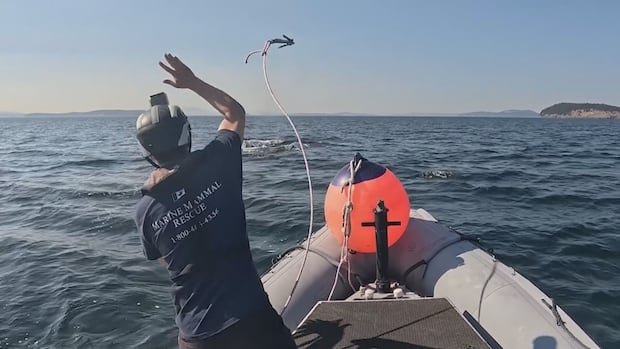

Marine mammal rescuers operating on Vancouver Island have reported a surge in whale entanglements this summer. Paul Cottrell, the marine mammal coordinator at Fisheries and Oceans Canada, revealed that his team has been tackling an average of one to two entanglements weekly over the past two months. This rate aligns with last year’s figures, along with conducting several necropsies.
In the latest incident last week, the team responded to their third call in less than two weeks. They encountered a humpback whale calf entangled in over 100 meters of rope near the south coast of Vancouver Island, accompanied by its mother. The calf had been dragging the rope since July 5 when it went missing from B.C.’s central coast, a detail identified by tracking the gear.
After a seven-hour effort in collaboration with U.S. counterparts, the team successfully freed the calf. Cottrell expressed the team’s elation in saving the calf, emphasizing the significance of each animal’s well-being.
Prior to this rescue, the team had handled two entanglement cases in two consecutive days. They spent a day and a half disentangling a whale named Wiggins for the second time in a year near French Creek on the eastern coast of Vancouver Island before rushing to the central Island and the Alberni Inlet for another rescue operation.
Cottrell noted the escalating frequency of such incidents with no signs of entanglement rates declining. He highlighted the increasing presence of humpback whales in inshore waters in British Columbia, attributing it to a positive conservation narrative but lamenting the concurrent rise in entanglements due to inshore fishing gear overlap.
Jackie Hildering, a researcher and educator at the Marine Education and Research Society (MERS), underscored the progress in humpback whale conservation efforts, describing it as a “second chance” for a species once on the brink of extinction. However, she expressed concerns over missed opportunities in safeguarding this chance.
Hildering emphasized the prevalence of entanglement issues among whales, citing her research findings that 50% of observed whales exhibited signs of previous entanglements. She stressed the necessity of prevention and education as more effective strategies than reactive disentanglements, advocating for informed actions to mitigate humpback entanglements and fatalities.
Promoting a whale-safe boating course developed by MERS with federal government backing, Hildering urged individuals on water bodies to enhance their knowledge and contribute to reducing humpback entanglements and casualties.