
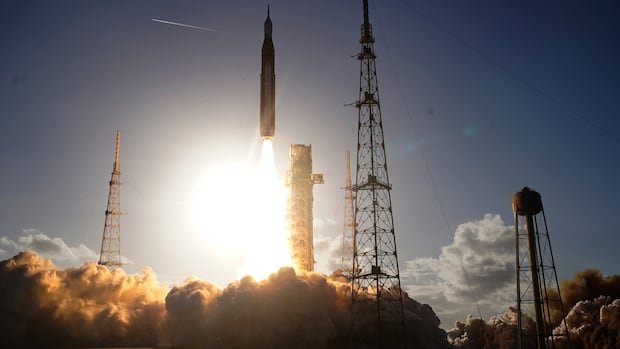

NASA’s Artemis program has garnered attention for its initiative to send astronauts around the moon. However, beyond this mission lies a broader strategic competition between the United States and China to reignite human presence on the lunar surface. This new race extends beyond mere symbolic gestures of planting flags and footprints; the first nation to succeed could potentially dictate the location of future lunar infrastructure, establish technical standards, and shape the trajectory of forthcoming space exploration endeavors.
During NASA’s recent Ignition event, officials underscored the imperative nature of this contest. NASA aims to land Americans on the moon before China, specifically before the conclusion of U.S. President Donald Trump’s term. Jared Isaacman, the billionaire designated by Trump to lead NASA, emphasized the time-sensitive nature of the race by stating, “The difference between success and failure will be measured in months, not years.”
The battle is now set into motion, primarily on a political front. While NASA is fast-tracking efforts to achieve this goal by early 2028, China’s chief designer for the lunar program, Wu Weiren, has confidently declared that “By 2030, the Chinese people will definitely be able to set foot on the moon.”
Casey Dreier, chief of space policy at the Planetary Society, expresses skepticism regarding the feasibility of the 2028 target but acknowledges China’s role in stimulating NASA’s endeavors. China’s steadfast commitment to lunar exploration serves as a catalyst for garnering political support.
This contest is perceived as a marathon rather than a sprint, with the objective being not only to reach the moon but to establish a permanent presence. Dean Cheng, a senior fellow at the Potomac Institute for Policy Studies, notes China’s track record of fulfilling ambitious space goals, lending credibility to their 2030 lunar target.
While some view this as a competitive race, Kevin Olsen, a Canadian research fellow, argues that cooperation is also significant. The Artemis program, not confined to American efforts alone, involves collaboration with international partners like the Canadian Space Agency, the European Space Agency, and JAXA. This collective effort signifies a departure from the nationalism that characterized the Apollo missions.
The significance of the moon’s south pole cannot be understated, with both the U.S. and China eyeing this region for potential lunar bases due to the presence of water ice in permanently shadowed craters. Water resources on the moon could serve multiple purposes, including sustenance for astronauts and raw material for rocket fuel.
The urgency to establish a presence in this region is underscored by the potential benefits of exploiting water resources. The country that lands first may secure priority access to strategically valuable sites for future operations.
The accelerated pace of lunar missions is crucial, as highlighted by Isaacman at the Ignition event. The focus is on increasing the frequency of lunar expeditions to maintain a competitive edge in space exploration.
Funding remains a significant challenge for NASA, necessitating reliance on private industry for spacecraft development. SpaceX and Blue Origin, led by billionaires Elon Musk and Jeff Bezos, respectively, are in a race to provide the lunar lander for NASA’s missions. The outcome of this competition will influence NASA’s lunar exploration capabilities.
The dynamics of this new space race differ markedly from past endeavors, characterized by a blend of international collaboration and private enterprise in the U.S. and long-term state planning in China. The moon is viewed not just as a destination but as a precursor to deeper space exploration ventures, including missions to Mars and beyond.