
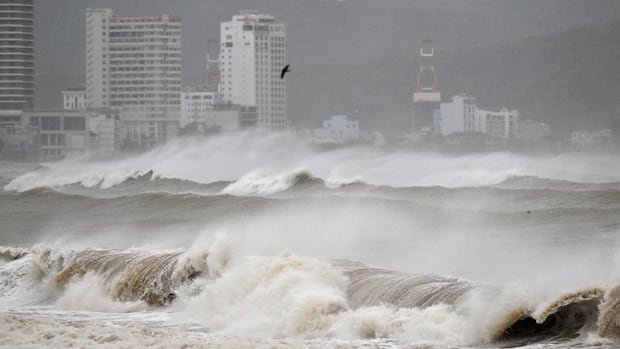

Typhoon Kalmaegi made landfall in Vietnam on Thursday, leading to the cancellation of numerous flights and prompting authorities to advise residents to stay indoors. Following its destructive path through the Philippines where it claimed the lives of at least 114 individuals, Kalmaegi brought winds reaching speeds of up to 149 kilometers per hour as it hit the central coast of Vietnam, causing widespread damage including roof damage to homes, uprooted trees, and toppled telegraph poles. The storm also generated waves as high as 10 meters.
In response to the impending disaster, officials closed six airports and evacuated over 260,000 people in Gia Lai province to safety. This marks the 13th storm to impact Vietnam this year, ranking among the most potent ones. The government mobilized more than 268,000 soldiers for potential search and rescue missions, anticipating floods in low-lying areas and potential agricultural setbacks, particularly in the Central Highlands, a key coffee-producing region.
As the storm bore down on the region, precautions were taken with the closure of establishments along Cua Dai beach near the historic town of Hoi An. In the aftermath of recent floods that killed 47 individuals near the coastal city of Hue, residents were understandably apprehensive about the incoming storm.
Vietnam’s aviation authorities cautioned that operations at eight airports, including Da Nang International Airport, could be impacted. Meanwhile, Hoi An and Hue were already grappling with recovery efforts following recent flooding that claimed the lives of 35 people.
In a separate context, the Philippines declared a state of emergency in response to the havoc wreaked by Typhoon Kalmaegi. Nearly two million people were affected, with over 560,000 individuals displaced, including about 450,000 seeking refuge in emergency shelters. The province of Cebu, one of the hardest-hit areas, witnessed extensive destruction, with homes flattened, vehicles overturned, and streets obstructed by debris.
Preemptive measures led to the evacuation of over 200,000 people in the Philippines before the typhoon made landfall. Residents in Cebu faced the heartbreaking reality of returning to destroyed homes, necessitating a strenuous cleanup effort to restore some sense of normalcy. Authorities stressed the urgency of debris removal to facilitate rescue operations and account for missing individuals.
With the departure of Typhoon Kalmaegi from Philippine territory, meteorologists are monitoring a developing storm east of Mindanao that could intensify into a typhoon, posing potential risks for the upcoming week. The aftermath of Kalmaegi, the 20th storm to hit the Philippines this year, compounds the challenges faced by communities still recovering from a recent earthquake that claimed lives and displaced numerous residents in northern Cebu.