
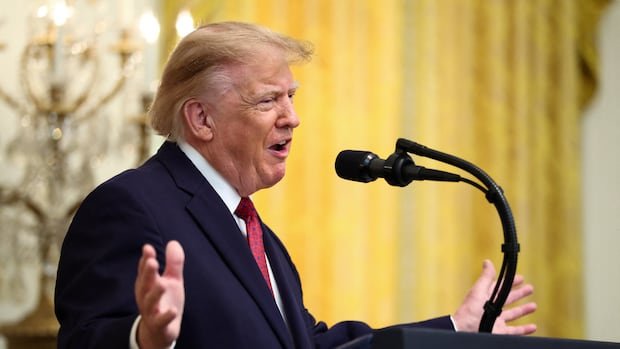

U.S. President Donald Trump escalated his verbal feud with Canada on Wednesday during an event honoring Hispanic Heritage Month at the White House. Trump criticized Canadian leaders, labeling them as “very bad,” and blamed past U.S. administrations for allowing automakers to relocate assembly plants, including to Canada.
While Canada has had a robust auto manufacturing industry since 1904, Trump asserted that previous presidents permitted other countries to produce cars for the U.S. market. He emphasized his administration’s imposition of high tariffs to change this practice, aiming to impact Canada’s auto sector significantly.
Trump accused Canada of taking advantage of the U.S. for many years, calling them the worst offender. He highlighted his decision to rename Lake Ontario to “Lake America” as part of the measures to address what he perceives as unfair practices by Canada.
The President’s remarks coincided with the recent implementation of an import ban on various Canadian products, such as molasses, motorcycles, dairy items, and alcohol. Notably, the restrictions on Canadian alcoholic beverages could have a substantial economic impact, with Canada exporting approximately $1.2 billion worth of alcoholic drinks last year.
In response to the import ban, U.S. Trade Representative Jamieson Greer cited Canadian liquor regulations and procurement restrictions as key issues affecting the trade relationship. Greer indicated that the ban was a retaliatory measure following Canada’s response to previous U.S. tariffs.
Trump’s trade adviser, Peter Navarro, also criticized Canada, describing Canadian leaders as arrogant and accusing them of exerting undue influence on U.S. policymakers. Despite the tensions, Canadian Prime Minister Mark Carney expressed willingness to negotiate a mutually beneficial trade agreement with the U.S.
While the Trump administration has raised concerns about trade imbalances with Canada, data suggests that the U.S. maintains a trade surplus in services with its northern neighbor. Despite Trump’s complaints about tariffs, most U.S. agricultural exports to Canada enter duty-free, with the majority of Canada’s agricultural imports originating from the U.S.