
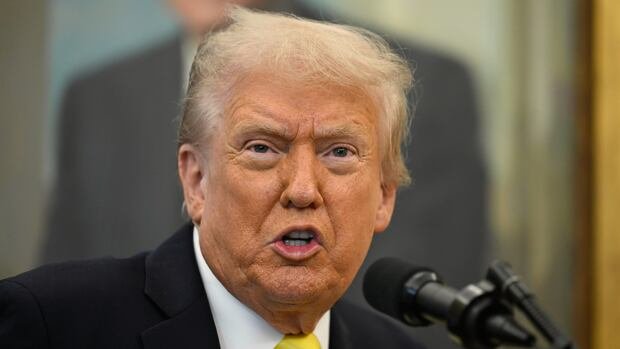

The Supreme Court is reviewing President Donald Trump’s utilization of the 1977 International Emergency Economic Powers Act (IEEPA) for implementing extensive global tariffs. If the court rules against Trump, it would remove a key tool he uses to penalize countries on non-trade political issues that provoke his displeasure. The challenge, initiated by small business organizations and various states, is being considered by the court’s conservative majority, including three justices appointed by Trump. The timeline for the court’s decision remains uncertain.
Trump is the first president to apply this statute, which is typically used for imposing economic sanctions on adversaries, to impose tariffs. The statute grants the president authority to address threats to U.S. national security, foreign policy, or economy. Trump justified the tariffs by declaring a national emergency due to a $1.2 trillion U.S. goods trade deficit in 2024, despite the country running trade deficits annually since 1975.
In case the Supreme Court invalidates the IEEPA-based tariffs, U.S. Treasury Secretary Scott Bessent mentioned that alternative tariff authorities, such as Section 122 of the Trade Act of 1974 and Section 338 of the Tariff Act of 1930, could be utilized. Trump is already employing various tariff provisions, including Section 232 of the Trade Expansion Act of 1962 and Section 301 of the Trade Act of 1974, for imposing tariffs in different sectors.
Critics argue that the Constitution allocates tariff and tax authority to Congress, not the president. They claim that the major questions doctrine, requiring clear congressional authorization for significant executive actions, should nullify Trump’s tariffs. Despite ongoing legal challenges, Trump’s administration defends the tariffs as beneficial for negotiating trade concessions with major partners.
Financial markets could face uncertainty if the Supreme Court overturns the IEEPA tariffs, as it could impact revenue collection and government spending. The reliance on tariff revenue poses a political and economic risk, potentially hindering future administrations from reducing tariffs. This dependency on tariffs raises concerns about the long-term implications on government finances and trade relationships.