
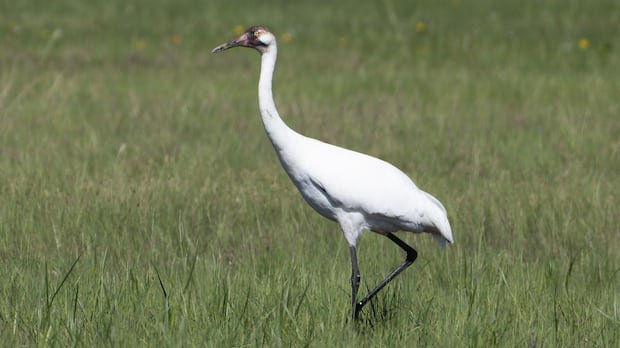

Standing at a towering height of five feet, a striking five-foot-tall bird with dazzling white feathers caught the attention of Calgary birder Jonah O’Brien. Upon hearing reports of a whooping crane sighting along a rural road an hour northeast of Calgary on a Tuesday morning, O’Brien wasted no time in heading to the location.
Expressing his excitement, O’Brien, who has meticulously documented over 270 bird species during his birding pursuits, described the encounter as “really cool.” This marked his inaugural sighting of a whooping crane, a highly sought-after species by birdwatchers in Canada.
Traditionally, birdwatchers seeking whooping cranes in Canada make their way to Saskatchewan during the fall migration season. Therefore, the unexpected summertime appearance of the whooping crane in Kneehill County was a delightful surprise for bird enthusiasts in the Calgary area.
Distinguished as the tallest bird in North America, the whooping crane can be identified by its imposing size, all-white plumage, unique facial markings, and black wingtips visible in flight. The sole remaining natural migratory flock of whooping cranes embarks on a journey of 4,000 kilometers from their winter abode in Texas to their breeding grounds in the remote wetlands of Wood Buffalo National Park each year.
Currently, the flock of approximately 550 birds is spending the summer nearly 1,000 kilometers north of Calgary, situated within the park that straddles the border with the Northwest Territories. This particular crane, being far from its usual habitat, is considered a “vagrant” in the birdwatching community, denoting a bird found outside its typical range.
Apart from the bird’s unusual location, the sighting has stirred excitement among birdwatchers for another reason. Gavin McKinnon, co-author of “A Field Guide to the Birds of Alberta,” hailed the whooping crane as a symbol of a successful conservation effort.
Decades ago, wild whooping crane populations dwindled to a mere 20 individuals in the 1940s, primarily due to hunting and habitat destruction, pushing the species to the brink of extinction. However, stringent legal protections, habitat preservation initiatives, and intensive captive breeding programs have facilitated a remarkable recovery in the wild whooping crane population.
McKinnon emphasized the importance of respecting the bird and maintaining a respectful distance to avoid causing stress. He noted that this particular whooping crane is likely a young non-breeding bird, citing similar atypical sightings in recent years around southern Alberta. The birdwatching community remains hopeful that the crane may eventually return to Wood Buffalo to breed in the future.