
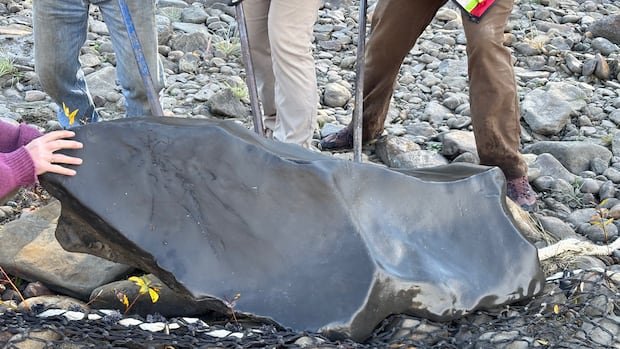

A marine reptile known as an ichthyosaur has had its fossilized skull unearthed in the Kiskatinaw River valley in British Columbia, approximately 52 kilometers south of Fort St. John. The discovery was made by local resident Kevin Geist and his 11-year-old son Andreas, who stumbled upon the skull two summers ago while exploring the river’s shoreline in the fossil-rich Peace region. Record-low water levels in the Kiskatinaw River, attributed to a prolonged drought lasting four years, have led to the exposure of more rocks, including the one containing the ancient skull.
Geist initially mistook the unusual black rock for something insignificant but later, upon revisiting the site this summer, his sister-in-law Diana Hofmann shared pictures of the find with the Tumbler Ridge Museum, sparking significant interest. Subsequent examination by the museum confirmed the skull as that of an ichthyosaur, a marine reptile resembling a cross between a dolphin and a fish, well-adapted to an aquatic lifestyle.
The Tumbler Ridge Museum Foundation’s resident paleontologist, Eamon Drysdale, explained that the ichthyosaur likely perished during the Triassic period, although the skull’s presence in a river valley dating back to the Cretaceous period is unusual. The skull, encased in carbonate rock from the Triassic era, is believed to have been transported by a glacier into the valley following the formation of the Rocky Mountains.
Drysdale highlighted the fossil-rich nature of the Peace region, noting that fossils in the area can date back as far as 500 million years, representing a significant portion of Earth’s history. While the valley harbors diverse fossils from various time periods, the discovery of the ichthyosaur skull hints at the potential for more fossil finds, especially with lower water levels uncovering additional fossil-bearing rocks.
To safeguard the skull, it was airlifted by helicopter and transported to the museum. Drysdale emphasized that community involvement, starting with the Geist family, played a crucial role in the successful recovery of the specimen. The museum’s ongoing efforts to study and interpret the ichthyosaur skull underscore the significance of local contributions to paleontological discoveries in the region.