
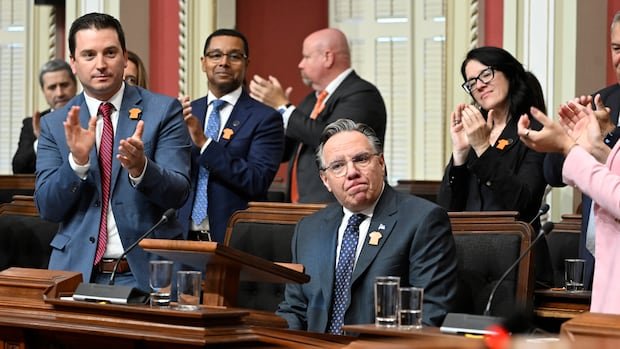

Premier François Legault’s strong commitment to protecting Quebecers from “radical Islamists” by prohibiting public prayer has sparked a renewed discussion that has been a significant focus in the province for the past two decades. Addressing the National Assembly, Legault expressed concerns about threats to Quebec’s identity from what he termed as “politico-religious” groups.
The Parti Québécois, currently leading in opinion polls under leader Paul St-Pierre Plamondon, not only supports the Coalition Avenir Québec (CAQ)’s proposal to ban public prayer but also suggests banning elementary school students from wearing religious symbols.
Stephen Brown, president of the National Council of Canadian Muslims (NCCM), described the current situation as a competition between nationalist parties to implement restrictive policies hindering minorities from expressing their differences.
The secularism movement in Quebec traces back to the 1940s and ’50s, during the dominance of the Catholic Church. The Quiet Revolution in the ’60s marked a pushback against the church’s influence, leading to the modernization of Quebec as the government took control of crucial sectors like health and education.
The aftermath of the 9/11 attacks shifted focus towards Islam in Quebec, prompting debates on reasonable accommodations for religious groups. Controversies arose, such as a sugar shack adapting its facilities for Muslim visitors, fueling public discontent.
Subsequent governments proposed various secularism measures, including the infamous charter of Quebec values in 2013 and the current Bill 21, which restricts public servants from wearing religious symbols. The CAQ government, utilizing the notwithstanding clause, aimed to safeguard Bill 21’s legal standing.
Despite the government’s claim that Bill 21 resolved the secularism debate in Quebec, challenges persist, with the Supreme Court scrutinizing the use of the notwithstanding clause. Recent proposals extend the ban on religious symbols to school support workers, indicating ongoing debate and potential further restrictions on secularism.
Quebec’s unique interpretation of secularism, often termed “laïcité,” signifies a deeper separation of religion from the public sphere, distinct from the traditional concept of secularism. The use of secularism as a political tool has sparked debate and alienated some communities, with concerns over Quebec’s direction and treatment of minorities. The future of Quebec’s secularism debate remains uncertain, with ongoing legal battles and political maneuvers shaping the narrative.