
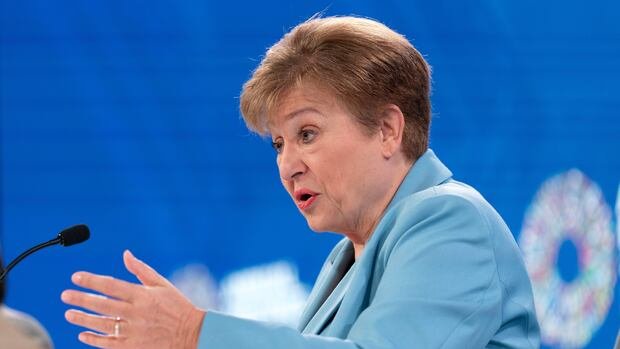

The chief of the International Monetary Fund (IMF) has remarked that Canada holds a favorable fiscal position among the G7 nations, despite the Liberal administration planning a larger deficit this year. IMF Managing Director Kristalina Georgieva made this observation regarding the fiscal well-being of advanced economies worldwide during a press conference at the IMF’s annual gathering in Washington on Thursday.
Georgieva highlighted that while some G7 nations face more substantial fiscal challenges, others, including Germany and Canada, fare relatively better. She recommended that Canada leverage its fiscal flexibility to stimulate growth amidst global economic uncertainties.
The IMF recently issued a report forecasting a gradual decline in global growth from 3.3 percent in 2024 to 3.2 percent in 2025 and further to 3.1 percent in 2026. The report warned of potential growth impediments such as prolonged uncertainty, protectionist measures, and labor market disruptions.
Canada has felt the impact of tariffs imposed by U.S. President Donald Trump, with the IMF estimating a slowdown in growth to 1.2 percent for the country this year. The Liberal government, under Prime Minister Mark Carney, is preparing to unveil its budget on November 4, prioritizing “nation-building projects” in response to the trade challenges. Carney has also committed to reaching the NATO defense spending target of 2 percent of GDP by 2026, signaling a likelihood of a larger deficit compared to the previous year.
Although the Parliamentary Budget Officer (PBO) has projected a higher deficit for Canada, interim PBO Jason Jacques has expressed concerns about the fiscal situation, describing it as “stupefying” and “unsustainable.” In contrast, former PBO Kevin Page disputed Jacques’s assessment, asserting that Canada remains in a stable fiscal position compared to other G7 countries.
Moreover, the Liberals have announced a shift in budgetary practices, with future budgets to be presented in the fall instead of the spring. They also intend to segregate day-to-day operational spending from capital investments, aiming to balance operational expenses within three years. While there are differing views on the broadness of the capital investment definition, the IMF’s Georgieva commended the new budgetary framework as a positive development, aligning with appropriate fiscal practices.