
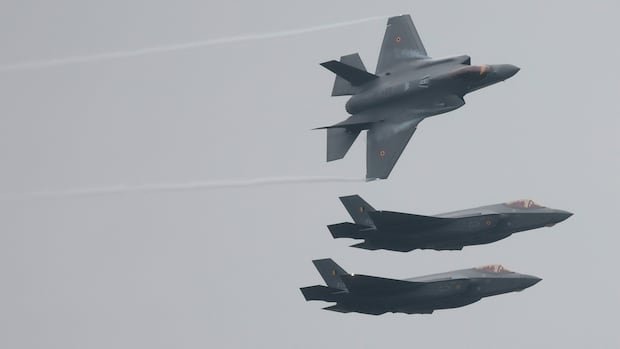

The Canadian federal Industry Minister is urging U.S.-based Lockheed Martin to offer more economic advantages in Canada for the planned purchase of 88 F-35 fighter jets. If not, Minister Mélanie Joly suggested in an interview that Ottawa might opt for a reduced number of F-35s and consider buying Gripen-E fighter jets from Saab in Sweden, with an option to have them assembled in Canada.
These discussions come as Prime Minister Mark Carney deliberates over the $27.7-billion fighter jet deal. Minister Joly outlined two potential directions for the F-35 evaluation initiated in March, shortly after Carney assumed office amidst U.S.-Canada tariff disputes.
The government could potentially negotiate additional economic benefits with Lockheed Martin to retain the full contract. Otherwise, they may proceed with acquiring a smaller fleet of F-35s. Canada is obligated by contract to purchase a minimum of 16 out of the planned 88 Lockheed Martin jets.
Minister Joly emphasized that the ultimate decision rests with the prime minister, but her aim is to leverage more from the F-35 contract with Lockheed Martin and continue discussions with Saab. While managing a mixed fleet could pose challenges for the Canadian Armed Forces, Joly expressed confidence, especially if there are added benefits.
As Canada gears up to boost defense spending significantly, Joly highlighted three key priorities: enhancing military capabilities, fortifying geopolitical alliances through new collaborations, and fostering job growth in the Canadian defense industry.
During recent parliamentary committee testimony, senior officials from National Defense and the Canadian Armed Forces voiced strong support for the F-35. They emphasized the importance of fifth-generation fighter jets like the F-35 for advanced stealth capabilities and rapid data processing.
Saab defended the Gripen fighter’s flexibility for rapid upgrades, challenging traditional “generational” aircraft classifications. Ottawa announced the F-35 purchase in 2023 after evaluating economic benefits from both Lockheed Martin and Saab.
Experts like David Perry and Philippe Lagassé raised concerns about Ottawa’s negotiation power and potential repercussions in discussions with Lockheed Martin. Lagassé cautioned against renegotiating the contract without expanding it, citing risks of straining U.S. relations.
For now, preparations continue for the arrival of Lockheed Martin jets within the Canadian Armed Forces, as officials remain committed to the existing contract arrangements until further notice.