
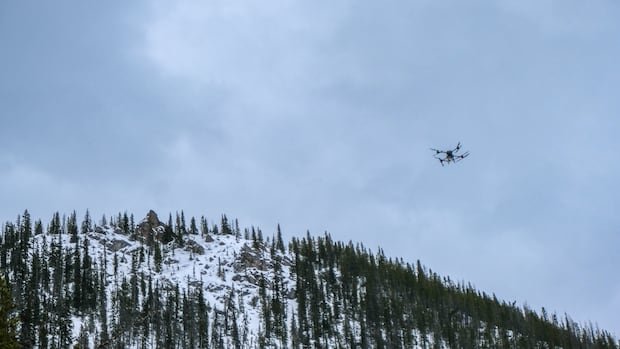

A Canadian company is employing drones for avalanche control instead of traditional methods like firing artillery weapons or dropping explosives from helicopters. The federal government granted Aerial Vehicle Safety Solutions Inc., (AVSS) permission to test its SnowDart system for avalanche control last year. AVSS conducted tests of this technology in Jasper National Park this winter. The company utilizes a drone to transport an explosive up a mountain, releasing it onto the slope for remote detonation. Josh Ogden, AVSS co-founder, views this as an additional tool in avalanche control strategies.
Historically, Canada has relied on various tools for avalanche control, including 105 mm howitzer guns used by the Royal Canadian Horse Artillery of the Canadian Armed Forces to trigger avalanches by firing shells onto mountain slopes. Parks Canada also employs helicopters to strategically drop explosives for avalanche triggers. In some areas, remote trigger stations are integrated into the slopes. Josh Ogden highlights drones as particularly beneficial for inaccessible regions without artillery guns or remote trigger stations, potentially offering a more cost-effective alternative to helicopters.
The winter season has been active for avalanche control in Western Canada, with Parks Canada managing a 43-kilometer stretch of Highway 1 through Glacier National Park in British Columbia. This winter, the highway experienced extended closures for avalanche control due to record snowfall in December and weather events like an atmospheric river in March. The Icefields Parkway, which spans from Jasper to Lake Louise in Alberta, faced a significant number of closure hours, marking the most prolonged closure duration in recent memory.
Drone technology is gaining traction across various industries, from bridge inspections to emergency responses and food deliveries. Drones are increasingly integrated into daily operations, with potential applications in managing avalanche risk. While drones may offer support in avalanche control, Deryl Kelly, a visitor safety specialist at Parks Canada, emphasizes that they cannot replace existing tools and are weather-dependent. AVSS plans to continue testing drone technology next winter, with the possibility of expanding its use to other mountainous areas in Canada.
Brian Rode, vice-president of the Marmot Basin ski resort in Jasper National Park, expresses optimism about the use of drones for avalanche control. The ski resort intends to monitor the technology’s progress and adoption in the market while maintaining its current use of explosive charges for avalanche control.