

A clothing and footwear revolution is on the horizon with the integration of AI technology. Aurmada, a Toronto-based start-up, is at the forefront of this trend, exploring ways to incorporate AI into garments and shoes for enhanced interactivity. The company’s CEO, Zavosh Zaboliyan, envisions a future where clothing goes beyond mere fashion to offer functional benefits through technology.
The demand for wearable technology is evident, with nearly 40% of Canadians owning such devices, as per a recent survey by Leger. While smartwatches dominate the current market, Zaboliyan believes that clothing will soon join the realm of tech-integrated accessories. He questions why our clothing has not kept pace with the technological advancements seen in other areas of life.
Zaboliyan’s personal experience following a car accident led him to establish Aurmada. Faced with the challenges of monitoring his own rehabilitation progress, he saw the potential for AI to provide real-time insights into physical conditions. By embedding AI into clothing, vital signs can be monitored, movements tracked, and potential hazards identified, offering a new level of health and safety support.
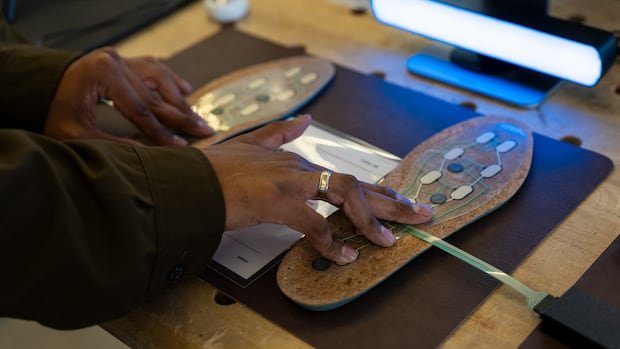
Aurmada recently unveiled its innovative designs at a technology showcase in Toronto. Among the showcased products were shoe sole sensors that analyze weight distribution to aid in injury rehabilitation. The team is also developing small sensors that can be integrated into clothing, acting as virtual assistants to answer queries.
To ensure the effectiveness of the embedded technology, Aurmada is experimenting with fabrics containing metals like copper and silver to shield sensors from external interference. The company envisions incorporating lightweight solar panels into the fabric for power supply. Additionally, Aurmada is working on “low-tech” solutions, including clothing items designed to provide heating or cooling through electrical currents and fans, catering to various needs.
Although still in the prototype phase, Aurmada has introduced non-AI-enhanced products like bulletproof shirts and conductive socks for muscle stimulation. The company’s focus is on creating purpose-built apparel for industries like security, defense, and manufacturing, where AI-powered sensors can enhance safety and efficiency.
The fusion of technology and fashion is not a new concept, with designers exploring ways to integrate tech elements into clothing for years. Initiatives like Adobe’s color-changing dress and Levi’s smartphone-connected jacket showcase the potential of merging fashion with functionality. Institutions like the Fashion Institute of Technology’s DTech Lab are at the forefront of such experimentation, pushing the boundaries of wearable technology.
While the future of AI-enhanced clothing looks promising, challenges like data privacy concerns and public skepticism towards AI adoption may hinder widespread acceptance. However, industry experts predict that with closer collaboration between fashion and technology sectors, stylish and functional wearable technology could become mainstream within the next decade.