
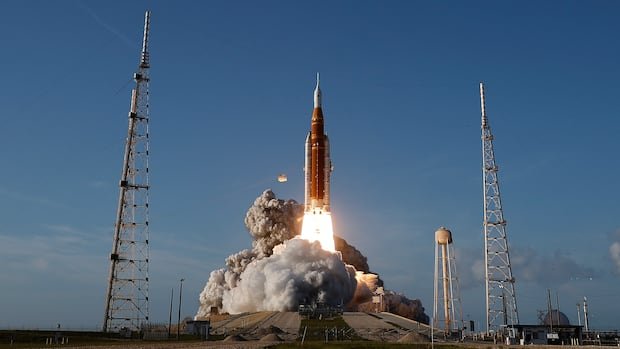

In an exciting development, a team of four astronauts, including Jeremy Hansen from the Canadian Space Agency, as well as NASA’s Reid Wiseman, Victor Glover, and Christina Koch, are embarking on a 10-day journey to the moon. The successful launch took place at 6:35 p.m. ET on Wednesday from the Kennedy Space Center, with spectators lining Florida’s Space Coast to witness the historic event.
Following a 54-year hiatus, NASA is once again sending astronauts to the moon, as stated by NASA administrator Jared Isaacman during a post-launch press conference. The crew of Artemis II will spend a day in Earth’s orbit conducting checks on their capsule before initiating the main engine that will propel them towards the moon, covering a distance of approximately 405,000 kilometers into space.
During the mission, the astronauts are evaluating systems aboard the Orion spacecraft to achieve various objectives. Shortly after liftoff, the solid rocket boosters detached and landed in the ocean, followed by the core stage. The crew will not head directly to the moon but will orbit Earth for around 25 hours, testing the manoeuvrability of the Orion spacecraft.
As they progress, the crew will deploy CubeSats for experiments and execute a translunar injection burn on Day 2 to set their course towards the moon. The team will conduct numerous experiments, including testing the human body’s response in space, performing a CPR demonstration in microgravity, and assessing communication systems through NASA’s Deep Space Network.
On Day 6, the crew will approach the moon, capturing images of the lunar surface and conducting observations rarely seen from Earth. They will experience a loss of signal when on the far side of the moon, interrupting communication with Earth for approximately 30 minutes. The mission includes testing radiation shielding, manual piloting, and health monitoring systems for the crew.
In preparation for future lunar surface missions under the Artemis program, the team is also testing laser communications and conducting ship-to-ship communications with the International Space Station. The ultimate goal is to pave the way for Artemis IV, expected to return astronauts to the lunar surface by 2028.
The Artemis II mission represents a significant step towards NASA’s renewed focus on lunar exploration, setting the stage for further advancements in space travel and scientific research.