
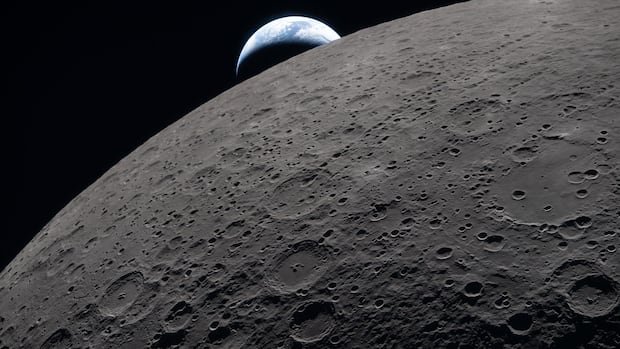

The astronauts of the Artemis II mission are on their way back home after witnessing a groundbreaking sight of the moon.
Jeremy Hansen from the Canadian Space Agency and NASA astronauts Reid Wiseman, Victor Glover, and Christina Koch set a new record by venturing farther from Earth than any humans before as part of Artemis II.
While satellites have captured images of the moon’s far side since 1959, when Luna 3 sent back the first photos, Artemis II allowed humans to directly see some far-side regions for the first time.
Kelsey Young, NASA’s Artemis II lunar science lead, has expressed anticipation about having humans observe and describe lunar features firsthand for a long time.
During a media conference, Young highlighted the ability of well-trained astronauts to make detailed color observations with just a glance.
The crew spent five hours making observations using cameras and their naked eyes, providing detailed descriptions of what they saw.
One area of particular interest was the Orientale basin, a region spanning the moon’s near and far sides, believed to have formed 3.8 billion years ago. Hansen pointed out color variations extending toward Hertzsprung, a large crater on the moon’s far side.
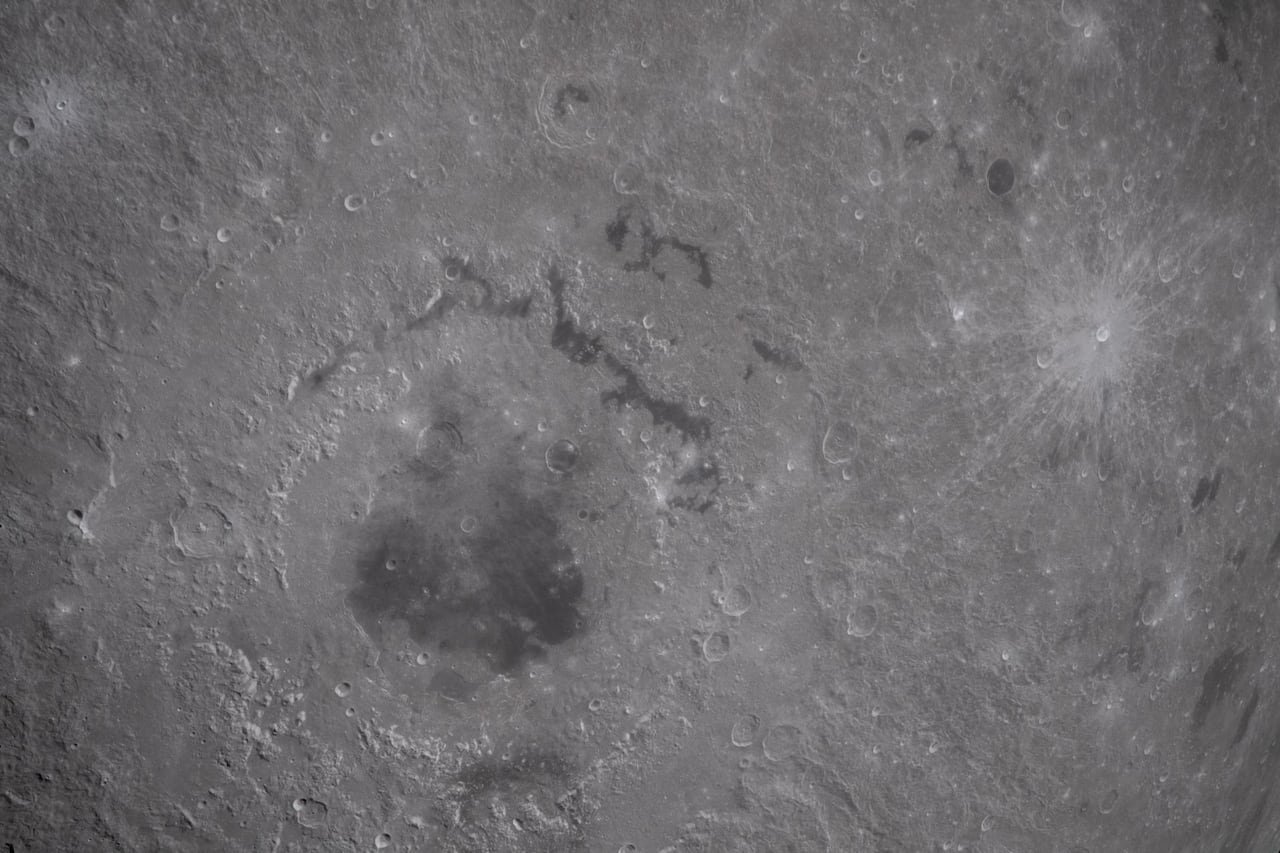
Although it may seem unusual, the moon does have colors, which can be seen by adjusting the saturation when taking photographs. The various colors are a result of different minerals on the lunar surface.
The human eye is more sensitive than a camera and can detect subtle differences in color and brightness without any adjustments.
Ralph Chou, professor emeritus at the University of Waterloo’s school of optometry and former president of the Royal Astronomical Society of Canada, explained that the human visual system is more discriminating than electronic systems and can detect differences more effectively.
Additionally, humans observing features in real time and in 3D provide another advantage.
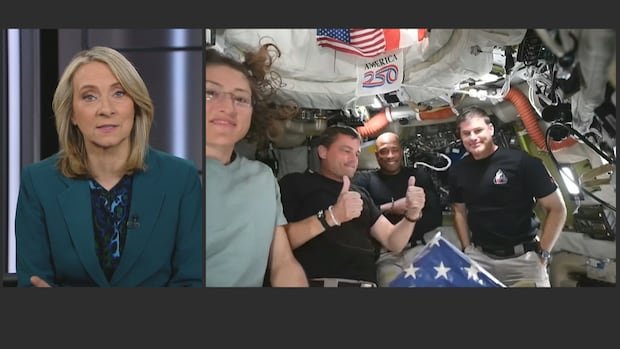
CBC News chief correspondent Adrienne Arsenault and senior science reporter Nicole Mortillaro host special coverage as the crew of NASA’s Artemis II moon mission provide a live update, and take questions, from the Orion capsule heading back to Earth.