
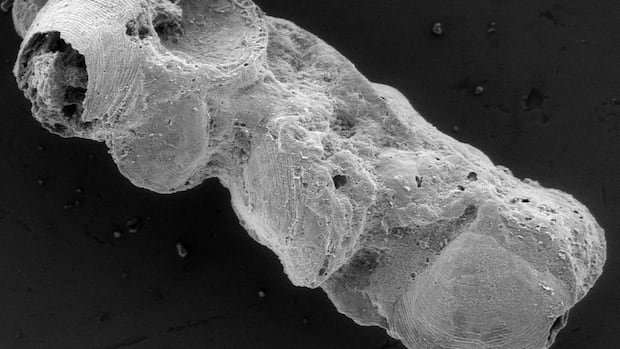

Long before the age of dinosaurs, a surge in biodiversity led to the appearance of early ancestors of modern animals and a rise in fecal matter. A recent study sheds light on the significance of coprolites, or fossilized feces, in understanding Earth’s ancient ecosystems, nutrient cycles, and animal interactions.
Published in the journal Trends in Evolution & Ecology, the research delved into fecal fossils from the Cambrian period, approximately 540 million years ago. By examining fecal records from primitive worms, invertebrates, and mollusk-like creatures, scientists discovered that fecal material played a crucial role in enhancing deep-sea ecosystems’ habitability and nutrient availability during that era, long before the age of dinosaurs.
The study’s revelation that feces were abundant during the Cambrian period holds key implications for comprehending the origins of present-day ocean ecosystems. Julien Kimmig, co-author of the paper and head of the paleontology division at the Karlsruhe Natural History Museum in Germany, emphasized the essential role of feces in sustaining both ancient and modern marine ecosystems, underscoring the importance of understanding the driving forces behind ecosystem dynamics and evolution.
Analyzing hundreds of coprolites from various deposits worldwide, Kimmig and co-author Russell Bicknell studied feces from burrowing worms, arthropods, brachiopods, and hyoliths. These fecal remnants evolved from microscopic forms to rabbit dropping-sized deposits within 15 million years into the Cambrian period, eventually becoming visible to the naked eye and containing shell or worm fragments.
Beyond unveiling insights into evolution and predator-prey relationships, the study of coprolites offers valuable clues about Earth’s ecological systems and the transformative impact of the Cambrian Radiation, a period marked by the rapid emergence of modern animal groups in the fossil record, also known as the Cambrian Explosion.
Researchers believe that paleontology’s relevance to modern society lies in understanding how past ecosystems adapted to environmental changes, offering insights that may inform predictions about future ecological scenarios. By exploring ancient ecosystems’ responses to shifts in temperature, oxygen levels, and nutrient availability, scientists can glean valuable lessons for anticipating and managing future ecological challenges.
The study underscores the essential role of coprolites in unveiling the mysteries of the Cambrian period, a pivotal era that laid the foundation for today’s diverse marine life. By examining waste products, nutrient cycles, and their cascading effects on biodiversity, researchers can gain a deeper understanding of ancient ecosystems and draw parallels with contemporary and future ecological landscapes.
Paleontologist Karen Chin, a prominent figure in the field, emphasizes the importance of studying coprolites to unravel the complexities of past ecosystems and interactions among ancient organisms. Despite the challenges posed by coprolite research, Chin advocates for greater attention to these fossilized feces, which offer unique insights into ancient life forms’ diets, behaviors, and ecological niches.
Chin’s work focuses on the Mesozoic era when dinosaurs roamed the Earth, highlighting how coprolites provide valuable information about ancient food webs, carbon cycles, and biological interactions. By studying coprolites, researchers can uncover surprising details about prehistoric ecosystems and gain a deeper understanding of the ancient world’s intricacies.
Kimmig’s early encounters with coprolites sparked his interest in exploring these overlooked fossils, leading him to delve deeper into their significance for paleontology. Encouraging broader interest in coprolites, Kimmig anticipates further discoveries that will enrich our understanding of ancient ecosystems and contribute to ongoing research in the field.