
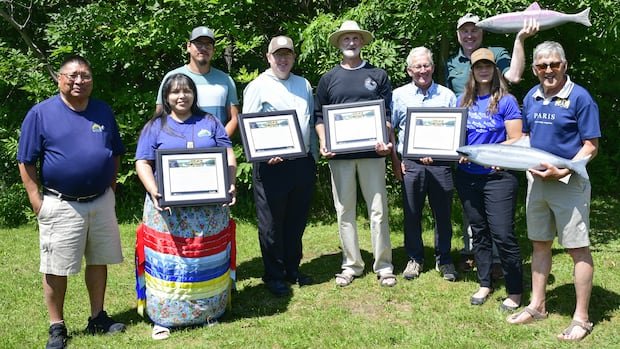

Shae Denny expresses astonishment at the global recognition of local conservation efforts in Cape Breton. Denny, an aquatic programs manager at the Unama’ki Institute of Natural Resources representing Cape Breton’s Mi’kmaw community, finds the acknowledgment very significant. The United Nations recently honored a collaborative seven-year project involving scientists, Indigenous groups, and volunteers aimed at restoring the Atlantic salmon population in Cape Breton Highlands National Park. The initiative, known as Respectful Returns and launched in 2010 by Parks Canada, focuses on ecosystem restoration through partnerships with Indigenous and local communities. The project has successfully rehabilitated over 65,000 hectares of land and 228 kilometers of waterways in seven national parks across Canada.
Denny, a member of the Eskasoni First Nation, highlighted the long-standing efforts of the Mi’kmaq community in addressing declining salmon stocks dating back to the 1950s. This led to the establishment of a salmon advisory committee involving Eskasoni Fish and Wildlife, Fisheries and Oceans Canada, and local river associations. Denny emphasized the importance of collaboration in achieving positive change, stating that collective efforts offer a comprehensive approach to conservation and management.
The restoration program in Cape Breton Highlands National Park commenced in 2019 after years of significant declines in the salmon population. Park ecologist Sarah Penney noted that in the 1980s, approximately 75 adult salmon returned annually from their ocean migration. However, by the 1990s and early 2000s, this number dropped to around 10 due to high mortality rates among young salmon before they could survive in the open sea. To address this, Parks Canada and its partners began capturing juvenile salmon from the Chéticamp River and Clyburn Brook each spring, raising them in captivity until they were ready to be released back into the wild. This hands-on intervention proved successful, with the number of spawning salmon meeting the conservation benchmark of 75 for the first time in three decades.
While Parks Canada officially received the World Restoration Flagship distinction from the UN in December, the agency held a ceremony on July 16 to honor four key groups in Cape Breton: the Unama’ki Institute of Natural Resources, the Atlantic Salmon Federation, and local salmon associations on the Chéticamp and Margaree rivers. Bill Haley, vice-president of the Margaree Salmon Association, expressed pride in being recognized alongside global initiatives like major reforestation projects in Papua New Guinea, highlighting the significance of the award as a testament to their collaborative efforts.
The project’s success underscores the importance of community partnerships and collective action in achieving significant conservation milestones.