
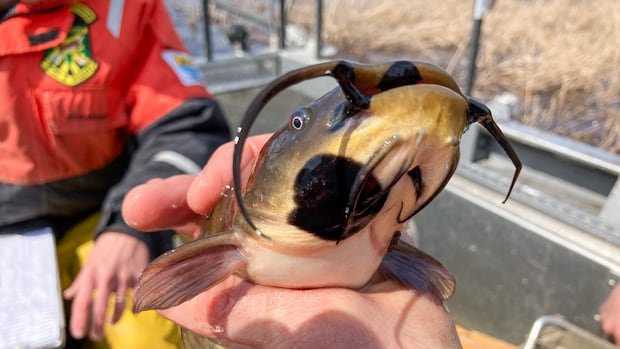

A recent genetic study has revealed a unique situation where cancerous melanoma tumors are spreading among catfish populations in Quebec and the northeastern U.S. This discovery marks the first documented case of transmissible cancer in fish and is one of only a handful of such instances ever recorded.
Julie Dragon, one of the leaders of the study, highlighted the rarity of transmissible cancers in nature, citing only three other known occurrences in Tasmanian devils, dogs, and shellfish. The researchers were intrigued by the unusual spread of melanoma tumors among brown bullhead catfish in Lake Memphremagog, which straddles the Quebec-Vermont border.
Initially reported by anglers in 2012, these tumors have now affected around a third of the brown bullheads in the lake. The sudden appearance of these tumors following a significant flood raised concerns about potential environmental causes. Subsequent tests found higher concentrations of certain metals and arsenic in the fish with tumors, though conclusive evidence of carcinogens remains elusive.
In 2014, Julie Dragon, an associate professor at the University of Vermont, investigated the possibility of a viral cause for the tumors but found no evidence of viruses. Further genetic testing revealed that the affected fish were not inbred and displayed significant genetic diversity. Surprisingly, the cancer cells were more similar to each other than to the host fish, leading to speculation about a potential transmissible cancer.
The study’s findings suggest that the tumors may be shed easily and could potentially be transmitted during spawning when adult fish come into close contact. While the transmission of these tumors between fish has not been conclusively demonstrated, ongoing research aims to verify this possibility.
While some experts remain cautious about labeling this as a transmissible cancer, others find the genetic evidence compelling. Government agencies in the U.S. and Vermont, along with Quebec’s Ministry of the Environment, have supported the research. Recommendations advise against consuming fish with tumors, although there is no evidence of harm to human health. Monitoring efforts are ongoing in various water bodies to track the spread of these unique cancerous tumors among catfish populations.