
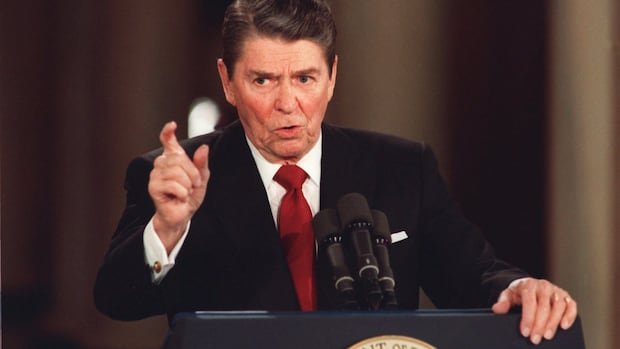

An advertisement from the Ontario government that drew the ire of U.S. President Donald Trump has been deemed successful by experts in political communication, despite not yielding the expected results from provincial officials. It is anticipated that the ad will not encounter significant legal challenges in the U.S., where there is considerable leeway for political commentary.
The ad, currently airing in the U.S., includes audio excerpts critiquing tariffs from a 1987 speech by former U.S. President Ronald Reagan. Trump expressed his disapproval, labeling it as “fake,” which led to the abrupt termination of trade discussions and accusations against Canada for meddling in an upcoming U.S. Supreme Court ruling.
Alex Marland, a professor at Acadia University and a political messaging expert, commended the ad’s effectiveness in capturing attention and provoking a reaction from the president. Marland emphasized the importance of political advertising cutting through the noise, resonating with audiences, and garnering attention to be impactful.
While the ultimate achievement of Ontario’s objectives remains uncertain, Marland suggested extending the ad campaign for a few more days to capitalize on media exposure in the U.S. Premier Doug Ford announced the discontinuation of the $75 million campaign on Monday, citing successful outreach to U.S. audiences, including during the initial World Series games over the weekend.
Criticism of the ad by the Ronald Reagan Presidential Foundation and Institute, alleging selective use of the late president’s audio and video, has raised concerns about potential legal implications. However, Marland noted that the landscape of political advertising regulations has evolved, indicating limited concerns if the content is not manipulated or misleading unintentionally.
Jacob Neiheisal, an associate professor of political science at the University at Buffalo, echoed similar sentiments, noting the historical reluctance of U.S. courts to intervene in political speech unless it involves defamation or slander. Neiheisal cautioned that while the Ontario ad may attract attention in the U.S., it could provoke a backlash from Trump-supporting Republicans and be perceived negatively as external interference in American affairs.
Elly Alboim, a strategic communications expert at Earnscliffe Strategies and an associate professor at Carleton University, emphasized the ad’s effectiveness hinging on its reach and audience understanding. Alboim raised doubts about the ad’s call to action and its potential impact on viewers.
Alboim highlighted that Reagan’s speech is public domain, likening the use of speech excerpts in the ad to common journalistic practices. She also questioned the specific reasons behind Trump’s strong reaction to the ad featuring old footage of a former president, pondering the underlying triggers for his decision to halt negotiations.