
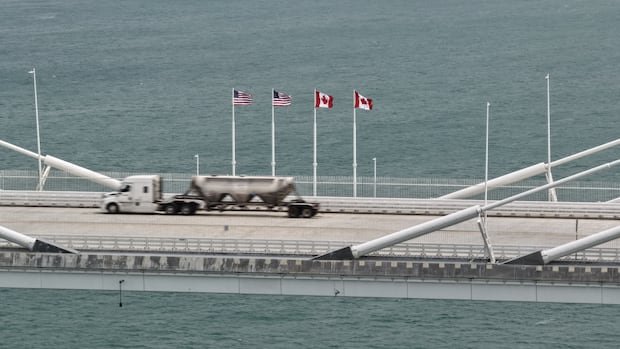

The unveiling of the Gordie Howe bridge is anticipated to enhance transportation efficiency between Canada and the United States, according to trucking companies. The new link connecting Detroit, Mich., and Windsor, Ont., is expected to streamline traffic, improve security processes, and offer competitive toll rates that could result in significant cost savings for large trucking firms. The Canadian Trucking Alliance CEO, Stephen Laskowski, mentioned that the bridge signals to investors and businesses that the trade corridor is open for business, leading to smoother cross-border transportation and potentially creating more jobs and economic growth.
The six-lane Gordie Howe International Bridge provides a direct route between Ontario’s Highway 401 and I-75 over the Detroit River. In contrast, the four-lane Ambassador Bridge requires navigating an off-ramp and numerous traffic lights on the Canadian side. The new crossing boasts modern X-ray imaging facilities for faster inspections and offers toll rates lower than those at the older privately owned Ambassador Bridge.
Despite the anticipated cost savings for trucking companies due to the new bridge, consumers may not see immediate reductions in prices, mainly due to high diesel fuel costs following recent industry challenges. The President of the Private Motor Truck Council of Canada, Mike Millian, highlighted that costs have increased significantly, influenced by factors like tariffs and global conflicts impacting oil prices.
After months of controversy surrounding the project’s finances, the Gordie Howe International Bridge officially opened to motorists, marking the first new crossing between Ontario and Michigan in over six decades. Despite political tensions that delayed joint celebrations between Canada and the United States, the bridge’s completion is seen as a positive development for trucking operations, providing smoother and more efficient transportation options for businesses and consumers.
The advanced features of the Gordie Howe bridge, such as enhanced customs facilities, streamlined inspection processes, and lower toll rates, are expected to benefit commercial carriers and reduce travel time by approximately 850,000 hours annually. The new bridge aims to improve trade flow between the two countries, offering a more cost-effective and efficient route for trucking operations.