
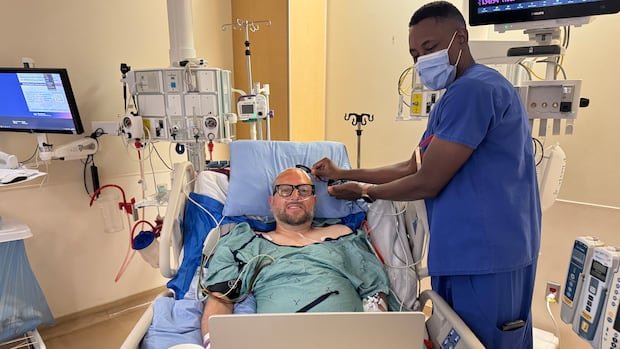

Sitting in his wheelchair, Lee Marten, a 48-year-old sergeant from the Vancouver Police Department currently on leave, gazes at the computer screen in front of him. He envisions moving the cursor across the screen, and in an instant, the arrow responds to his thoughts.
Marten, utilizing a Neuralink brain implant, types on a digital keyboard at a speed comparable to or even faster than human fingers, swiftly checking the latest Toronto Blue Jays score. Describing the experience as akin to science fiction, Marten expresses his amazement at the functionality.
Becoming one of the initial Canadian ALS patients to undergo the Neuralink brain implant on May 20, Marten is the 26th individual globally to partake in this groundbreaking procedure aimed at aiding those incapacitated due to ALS or spinal injuries. Other quadriplegic Canadians and a dual American-Canadian ALS patient have also received the implant.
Neuralink, owned by the controversial trillionaire Elon Musk, conducted the procedure at University Health Network’s Toronto Western Hospital, sparking criticism. Despite this, Marten views the implant as a potential enhancement to his quality of life and a means to advance scientific knowledge for the benefit of others.
Receiving a terminal ALS diagnosis after experiencing symptoms since April 2022, Marten’s journey included misdiagnoses before the devastating truth emerged. With ALS progressively debilitating his ability to walk and eventually impacting his speech and breathing, Marten’s resolve to adapt and contribute remains strong.
The Neuralink trial, known as CAN-PRIME, hosted by UHN’s Toronto Western Hospital, is part of a global initiative involving multiple countries, including the U.S., U.K., and Abu Dhabi. The procedure entails implanting over 1,000 microscopic electrodes into the brain’s motor cortex, enhancing the capacity for patients to control external devices via thought.
Despite facing initial apprehensions over a last-minute change in the surgical approach, Marten’s procedure was successful, marking a new milestone in medical technology. Post-surgery, he swiftly engaged with Neuralink engineers, showcasing the resilience and determination that define his journey.
Back in Vancouver, Marten continues his rehabilitation regimen, showcasing a determined spirit to connect with his family through innovative means even as ALS progresses. Embracing the opportunities afforded by technology, Marten’s story epitomizes the resilience and hope that can emerge from challenging circumstances.