
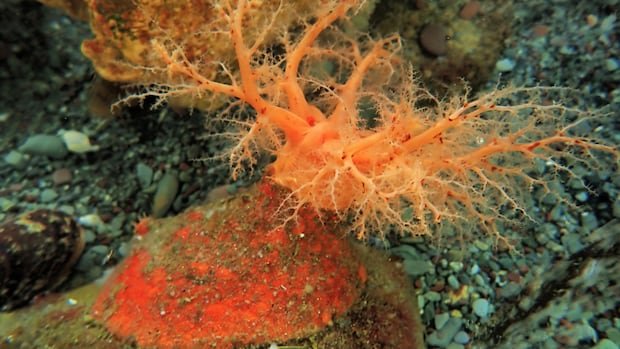

A doctoral student from Memorial University in Newfoundland and Labrador, Sara Jobson, has made a fascinating discovery about scarlet sea cucumbers. She found that amputated tissue from these creatures can survive independently for several years, displaying characteristics that blur the line between life and death.
Jobson and her team conducted a study published in Science Advances, where they observed pieces of scarlet sea cucumber tissue placed in seawater. The severed tissue exhibited a unique ability to sterilize the amputation site, seal the wound, and gradually transform into translucent blobs with red pigment nuclei over the course of a few years.
Despite displaying characteristics of living organisms such as nutrient absorption and an active immune system, the tissue samples did not reproduce, leading Jobson to coin the term ‘zombie tissue.’ These peculiar entities exist in a state between life and death, prompting questions about their evolutionary purpose.
Jobson highlighted the potential research opportunities presented by these resilient tissue samples and emphasized the importance of fostering curiosity-driven scientific inquiry. She credited her discovery to the supportive environment of the ocean sciences lab at Memorial University led by Professor Annie Mercier.
The implications of this discovery and the nature of these ‘zombie’ sea cucumber tissues raise intriguing scientific questions that Jobson aims to explore further, including investigating the aging process of the cells.