
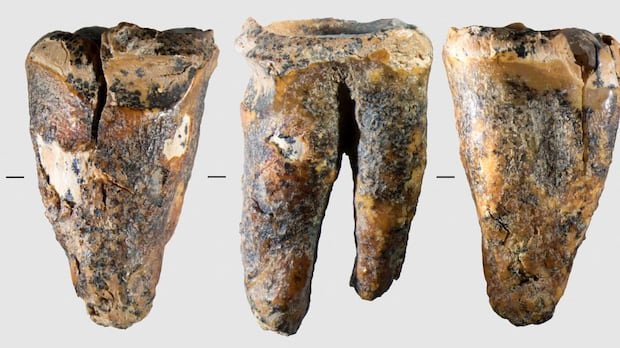

About 59,000 years ago, a Neanderthal residing in the Siberian mountains experienced severe tooth pain and took action. New research reveals a lower molar found in a cave in the Altai Mountains exhibited signs of dental work – a large hole seemingly drilled manually with a stone tool to extract decay. This discovery, detailed in a study published in the journal PLOS One, marks the earliest-known case of invasive dental surgery, predating homo sapiens’ documented cavity treatments. It suggests that Neanderthals, an extinct human species, were more advanced than previously acknowledged.
Anthropologist John Olsen, a study co-author, speculates on how a Neanderthal with a tooth infection would seek assistance, proposing two scenarios. One possibility is that the individual sought external help due to excruciating pain. The other scenario involves self-treatment, which Olsen deems less probable given Neanderthals’ social nature and similarity to modern humans.
While the concept of Neanderthal dentists is doubted, the tooth’s meticulous modification indicates a skilled practitioner may have performed the procedure. The fossil, discovered at Chagyrskaya Cave in Russia, underwent detailed examination revealing intentional drilling and not accidental damage or natural wear.
Comparative experiments on modern human teeth validated the findings, replicating the hole’s shape and microscopic features using a stone tool akin to those found at Chagyrskaya Cave. This dental intervention surpasses the previously known oldest procedure, conducted on a Homo sapiens tooth in Italy around 14,000 years ago.
The study highlights Neanderthals’ advanced cognitive abilities and medical strategies, challenging the notion that such sophistication was exclusive to modern humans. The tooth’s discovery suggests Neanderthals possessed planning skills, precise motor abilities, and deliberate medical approaches. This insight sheds light on their cognitive capacity and challenges outdated perceptions of their capabilities.
Neanderthals, an extinct sister species of humans, have been historically misrepresented in popular culture. Recent studies have revealed their artistic, technological, and social achievements, such as creating art, crafting tools, hunting with spears, wearing jewelry, conducting funerals, and providing medical care. These findings have reshaped the understanding of Neanderthals, portraying them as complex and skilled beings.
The significance of the tooth study lies not only in Neanderthals’ potential medical capabilities but also in their communication skills. The procedure, devoid of modern pain relief, indicates effective communication to convey the long-term benefits of enduring short-term pain. This challenges stereotypes of Neanderthals as primitive beings and underscores their capacity for complex communication.