
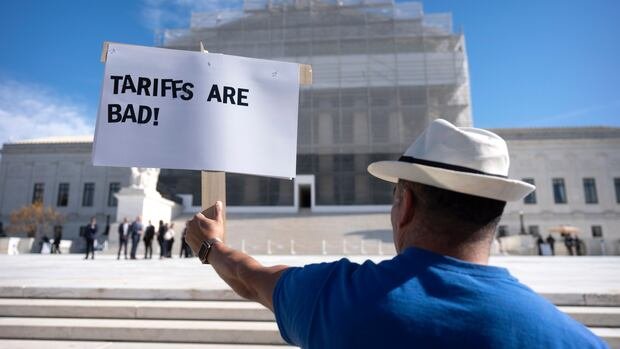

U.S. President Donald Trump decided not to participate in Wednesday’s Supreme Court oral arguments regarding his tariff policies, stating, “It’s not about me.” The notable figure present at the proceedings was Treasury Secretary Scott Bessent, until comedian John Mulaney unexpectedly appeared. Mulaney, who had previously discussed the similarities between Supreme Court arguments and stand-up comedy on Neal Katyal’s podcast, was in attendance. Lawyer Neal Katyal presented the case for small businesses suing the Trump administration over tariffs.
During the hearing, Katyal emphasized that tariffs function as taxes, transferring money from Americans to the U.S. Treasury, a power reserved solely for Congress by the U.S. Constitution. Trump’s Solicitor General John Sauer argued that the tariffs were not taxes borne by Americans, a point that faced skepticism from the court, including Chief Justice John Roberts and Justice Neil Gorsuch.
The Trump administration’s use of the International Emergency Economic Powers Act (IEEPA) to impose tariffs, a move unprecedented in presidential history, was challenged in lower courts. The Supreme Court hearing displayed a tone of skepticism, particularly from conservative justices, towards the administration’s arguments. Amy Howe from SCOTUSBlog predicted that the court is likely to strike down the tariffs in a 6-3 or 7-2 split decision, with the final ruling expected in the coming weeks or months.
If the tariffs are deemed unlawful, the Treasury may have to refund the $90 billion collected through them. However, the decision will not affect the Canadian-specific tariffs imposed by Trump on certain exports. These tariffs, initially imposed in March and increased to 35% in response to fentanyl trafficking, target specific Canadian goods under the Canada-U.S.-Mexico Agreement. U.S. tariff collections from Canada this year have amounted to $1.97 billion.
The Supreme Court’s decision on the tariffs remains pending, with implications for both the U.S. and Canadian economies.