
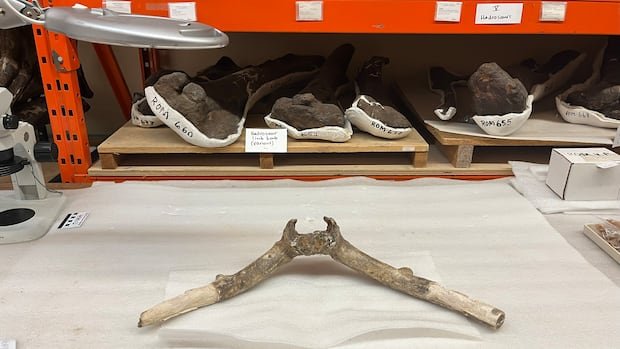

For almost five decades, a mysterious fossil discovered while building Islington subway station has kept its secrets hidden until now. A joint study by Trent University, the Royal Ontario Museum, and the Royal Alberta Museum has established a connection between the fossil and two deer species prevalent in North America.
According to Aaron Schafer, an associate professor at Trent University involved in the research, further analysis revealed that the fossil is closely related to whitetail and mule deer. However, it is likely a unique species that diverged approximately 3 million years ago. Dubbed as “Torontoceros hypogaeus” or the “horned Toronto deer from underground,” the fossil is estimated to be nearly 12,000 years old and offers insights into the past environment.
Oliver Haddrath, a collections technician at the Royal Ontario Museum, remarked that the deer appeared to be suited for a broader, more open habitat compared to the forested areas seen in recent centuries. He suggested that the landscape might have been more tundra-like, influencing the deer’s characteristics.
Looking ahead, Schafer mentioned the researchers’ interest in exploring the factors leading to the species’ extinction, indicating climate and genetic issues as potential causes. The technological advancements, particularly in DNA analysis, have enabled a deeper understanding of ancient specimens and their evolutionary history.
Although the fossil has been in the possession of the ROM since its discovery, identifying its origin was challenging due to technological limitations at the time. Haddrath highlighted the significance of the DNA lab in unraveling previously unanswered questions and placing ancient samples within their genetic lineage.
The ROM’s gallery housing the fossil is currently undergoing renovation, with plans to showcase “Torontoceros hypogaeus” to the public once the exhibition space reopens.