
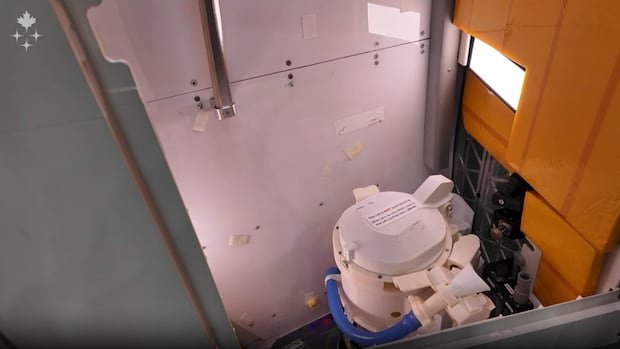

In a historic space voyage spanning 406,771 kilometers, four astronauts were accompanied by a specially designed toilet onboard the Artemis II spacecraft. The inclusion of this essential facility was crucial as humanity aims to push the boundaries of space exploration further than ever before.
The narrative of the Artemis II’s toilet, officially named the Universal Waste Management System, unfolded like a dramedy with multiple twists and turns. Following the successful launch on April 1, the crew encountered an immediate challenge as mission specialist Christina Koch reported a toilet malfunction about an hour into the mission. NASA astronaut Stan Love, serving as the crew’s contact at mission control, identified the issue as potential jamming caused by loose oxone beads in the fan separator.
After a few hours of troubleshooting, Koch managed to reboot the toilet, resolving the problem and restoring its functionality. Proudly dubbed the “space plumber” by Koch, the incident highlighted the critical importance of this piece of equipment in the spacecraft. NASA officials later explained that the glitch was likely due to a water priming issue, a common occurrence in such complex systems.
The Universal Waste Management System, situated in a compact space within the Orion capsule, differs significantly from conventional toilets due to the absence of gravity. Waste management involves fecal matter being vacuumed into sealed bags stored beneath the floor, while urine is directed into storage using individual hoses with airflow assistance. Periodically, the urine is vented into space, creating a visually striking frozen stream referred to as a “blizzard” by mission control.
Despite initial successes, challenges arose with the urine venting system freezing and clogging within a few days. To address this, the crew rotated the Orion capsule to expose the vents to sunlight, melting the frozen waste. This engineering issue was described as complex by Rick Henfling, Artemis II’s entry flight director, during a media briefing.
Inside the capsule, the crew also faced a mysterious odor emanating from the hygiene bay, prompting investigations by NASA. After ruling out potential causes, including the heaters and the toilet itself, the issue was deemed non-threatening. Despite initial concerns, subsequent reports confirmed the odor had dissipated.
A setback occurred when the toilet faced further issues with urine venting, leading mission control to implement a backup plan using Collapsible Contingency Urinals. While unconventional, this solution was necessary as the primary system required maintenance. Experts attributed the malfunction to bacterial growth prevention processes within the lines, a common challenge expected during the toilet’s maiden voyage.
Looking ahead, the hope is to address and resolve these technical glitches for future space missions. As Artemis II completes its journey with a splashdown in the Pacific Ocean, NASA teams plan to investigate the toilet’s performance for insights into the issues encountered. The ultimate goal is to refine and optimize the toilet system for extended space missions, ensuring operational efficiency for crews embarking on long-duration voyages like a potential Mars expedition.