
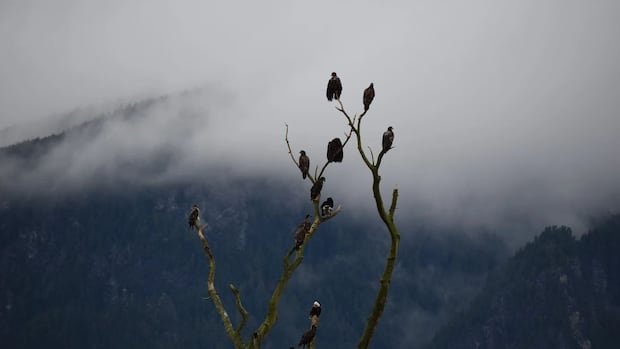

Every year during winter, tens of thousands of bald eagles migrate to the lower Fraser Valley, creating the largest gathering of eagles in the world, according to biologists.
The phenomenon is currently taking place along the Harrison River, where the return of salmon attracts eagles from as far as Alaska and Yukon.
From November to February, the area around Harrison Mills serves as a seasonal feeding spot for these birds as water bodies in the north freeze over, explained veteran bald eagle researcher David Hancock.
David Hancock, the founder of the Hancock Wildlife Foundation, specializing in raptor conservation, stated that most of the eagles migrating are from the north, seeking to escape the harsh winter conditions there.
He mentioned, “When lakes and rivers freeze in Yukon, Alaska, and northern British Columbia, the fish go under the ice, prompting the eagles to head south.”
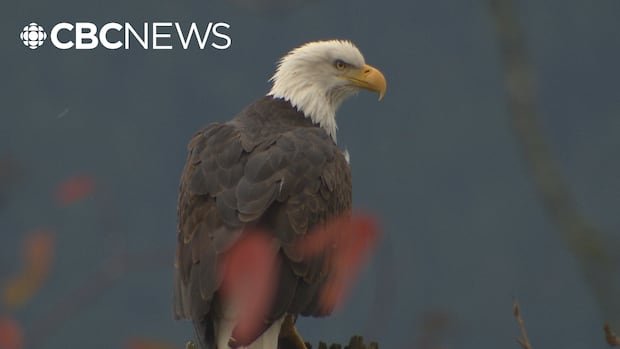
Thousands of eagles have gathered in the Fraser Valley. This annual migration sees the birds congregating in the Harrison Mills area to feed on salmon. Baneet Braich from our team witnessed this seasonal spectacle.
It is estimated that between 35,000 to 50,000 eagles pass through the region each winter.
Experts note that with the current peak of the salmon run, the conditions are optimal for the eagles.
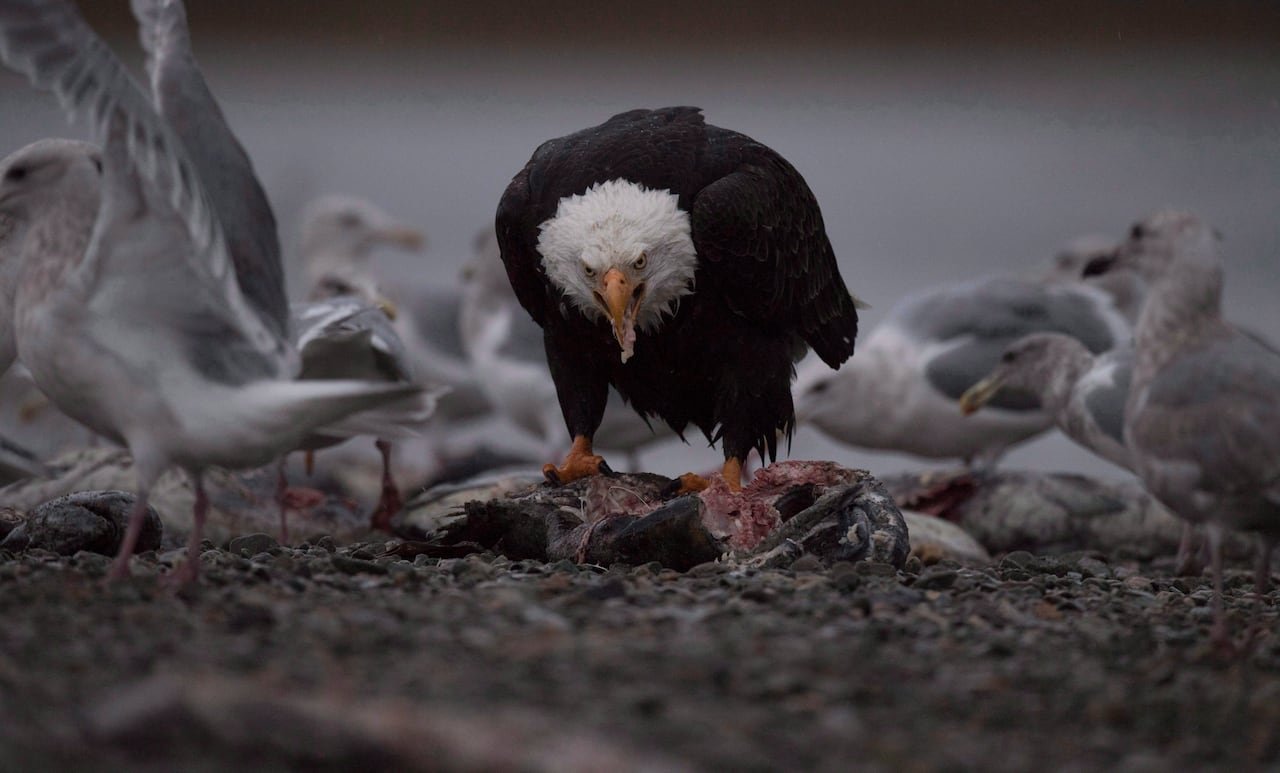
Rob Butler, an ornithologist and honorary director of the Pacific Wildlife Foundation, said, “We are right in the middle of the significant salmon run, and naturally, the eagles have returned. If the salmon run is abundant, the eagles will stay for an extended period along these rivers.”
During periods when the river lacks sufficient salmon, Butler explained that the eagles move to the coast, particularly along the Salish Sea shores, to hunt ducks for the rest of the winter.
“The ducks, of course, hope for a substantial salmon run,” he added.
The Harrison River stands out as one of Canada’s most productive salmon rivers, a critical factor that attracts the migration to this area rather than elsewhere in the province, according to Butler.
‘A remarkable recovery’
Both experts highlight that the annual congregation of eagles also showcases the significant recovery of bald eagle populations since their decline in the mid-20th century.
Hancock, who conducted surveys in the 1950s and 60s, initially counted only three breeding pairs across the Fraser Valley. Today, he reports approximately 700 pairs, marking a noteworthy resurgence.
- <a class="similarLink"