
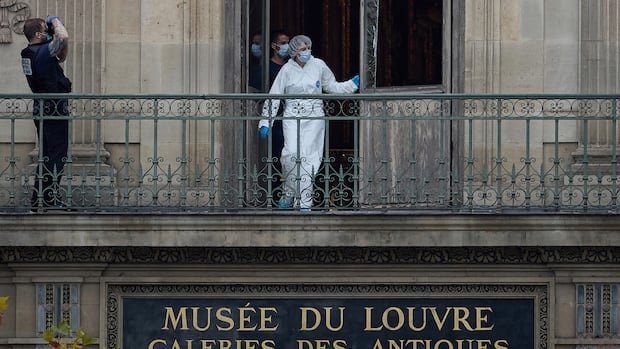

In the early hours of Sunday, thieves broke into the renowned Louvre museum, a globally acclaimed art institution. They accessed the elaborate Apollo Gallery and seized what remains of the French crown jewels, now estimated at 88 million euros or $143 million Canadian according to Paris prosecutor Laure Beccuau as of Tuesday.
The audacious daylight theft, dubbed “the heist of the century” by several newspapers, has captured worldwide attention in the hours and days following. However, within France, the incident has not only directly impacted the iconic museum but has also sparked a blame game.
Various reactions have surfaced, ranging from portraying the heist as an assault on French heritage to criticizing the museum’s lax security measures and emphasizing the need for heightened vigilance in museums globally.
Despite this incident, recent years have witnessed similar crimes: expensive porcelain was stolen from the Adrien Dubouche Museum in September 2025, and gold nuggets were taken from Paris’s National Museum of Natural History in the same month. In November 2024, 18th-century snuffboxes were stolen from the Cognacq-Jay Museum, followed by an armed gang stealing jewels from the Hiéron Museum in Paray-le-Monial.
Christopher Marinello, founder of Art Recovery International, highlighted that many museums face security challenges due to insufficient funding, underscoring the stark message sent by the Louvre heist given the museum’s global stature and funding.
The high-profile theft has turned into a political battleground and a platform for different government branches and political factions to advance their agendas. Opposition figures have seized the opportunity to criticize the government, labeling the theft a national disgrace amidst existing political turmoil in France.
Culture Minister Rachida Dati has oscillated between attributing the incident to mismanagement by museum leadership and defending the efficacy of the museum’s security systems. She emphasized the need to investigate the security lapses and enhance security measures in cultural institutions nationwide.
Questions have emerged regarding the Louvre’s security integrity and staff grievances about management practices. Staff discontent and security concerns have been ongoing, with recent protests highlighting working conditions and security vulnerabilities.
While plans for museum upgrades and enhanced security measures are underway, critics argue that these efforts come too late following previous warnings about security flaws. The ongoing investigation involves approximately 100 investigators working to track down the suspects and recover the stolen crown jewels.
The theft of the crown jewels, significant symbols of French history and identity, has exacerbated the impact of the crime. The historical importance of the stolen items has been emphasized, with experts and commentators describing the incident as a national calamity and an attack on French heritage.
Author Elaine Sciolino, known for her work on the Louvre, characterized the theft as a blow to France’s history and identity, questioning the implications for the nation’s cultural heritage and identity.