
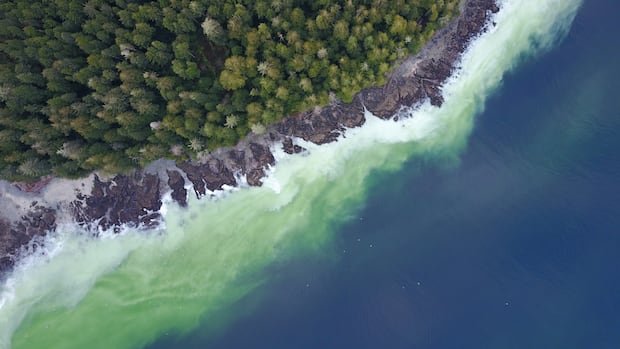

Ryan Cutler observed the ocean looking foamy from his residence near Salmon Beach on Vancouver Island’s west coast last week, signaling the onset of the herring spawn. Cutler, captivated by the spectacle, described it as a truly remarkable moment. Utilizing his drone, he captured the foamy, milky blue-green water, a clear indicator of herring gathering to reproduce in the shallow coastal bays.
The herring spawn marks a significant period for Vancouver Island and the South Coast, symbolizing spring’s arrival and a time for food gathering among some coastal First Nations. It also serves as a crucial juncture for marine conservationists, who monitor the declining population of these small, oily fish due to overfishing in recent decades.
Herring, as a keystone species, congregate in large numbers for breeding purposes. Females deposit eggs on kelp and eelgrass, while males release milt, creating the distinctive milky appearance of the water. Cutler noted the signs of staging, indicating the herring’s preparation for spawning, were evident in the preceding weeks, with sea lions, eagles, and humpback whales converging in the area.
Nick Chowdhury, the president of the Island Marine Aquatic Working Group, oversees a Facebook page that helps individuals track the herring spawn locations and timings. As a member of the Da’naxda’xw First Nation, Chowdhury emphasized the spawn’s importance for coastal First Nations, marking a transition in the seasons and a time for traditional food gathering.
Salmon Beach was among the initial spawning sites identified around Vancouver Island. Chowdhury highlighted the thrill of witnessing the annual herring spawn locations and assessing fish stocks, noting a resurgence of spawns in areas previously inactive. Tracking the spawn through the Island Marine Aquatic Working Group’s Facebook page aids in understanding the implications of conservation efforts and fishing quotas, shifting away from past practices of assuming endless fish abundance.
Shirley Louie, a seasoned fisher and member of the Stz’uminus First Nation, delved into herring knowledge a few years ago through a documentary project with the Q’ul-lhanumutsun Aquatic Resources Society (QARS). Working with six Coast Salish First Nations, QARS focuses on aquatic resource management for the region, promoting traditional food practices like smoking or frying herring. Louie’s exploration included learning to use a herring rake, emphasizing the value of reconnecting with traditional foods and practices.
Overall, the herring spawn serves as a pivotal event for various communities, wildlife, and conservation efforts along the coast, embodying a harmonious relationship with nature and traditional practices.