
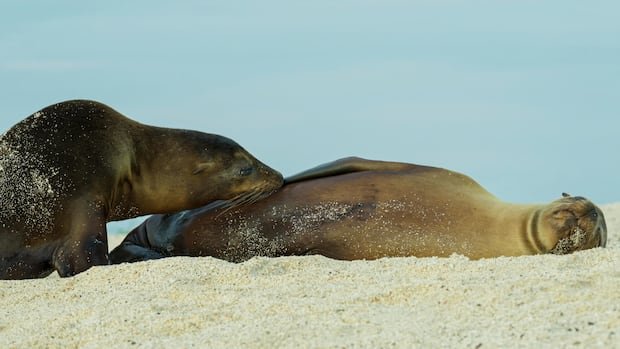

A recent study led by researcher Alexandra Childs sheds light on the unusual phenomenon of fully grown Galápagos Islands sea lions continuing to nurse from their mothers. Approximately 11% of the sea lion population in the Galápagos exhibit this behavior, referred to as “supersuckling.” This behavior, where sea lions feed on their mothers’ milk well into adulthood, challenges conventional expectations of weaning behavior in these marine mammals.
The study, published in the American Naturalist journal, analyzed two decades of data on Galápagos sea lions, scientifically known as Zalophus wollebaeki. While most sea lions typically wean from their mothers between 1.5 and 4.5 years of age, the supersucklers defy this norm by continuing to nurse beyond sexual maturity.
The research highlights instances of multigenerational suckling trains, where multiple sea lions engage in nursing behavior. This behavior, although observed in other species of sea lions and seals, is notably more pronounced in the Galápagos population.
Experts suggest that such prolonged nursing behavior may be linked to food availability and maternal investment in ensuring offspring survival and reproduction. The study indicates that supersuckling is more common during periods of ample food resources, suggesting a potential bonding function of the behavior.
While the reasons behind this behavior remain unclear, researchers speculate that it could serve immunological or social purposes. Further investigation is necessary to fully understand the drivers of supersuckling in Galápagos sea lions.