
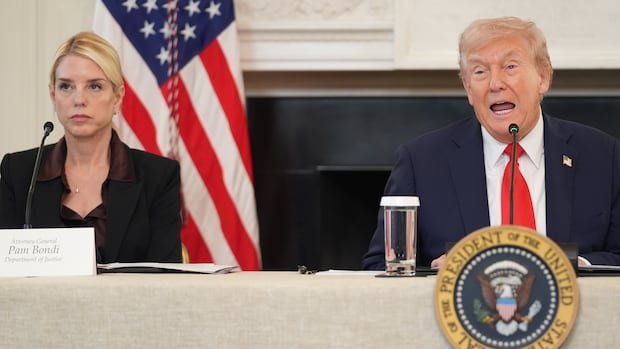

The U.S. President, Donald Trump, is working to convince Americans that the anti-fascist movement known as Antifa presents a significant threat to the nation comparable to established terrorist groups like Hezbollah. Trump, accompanied by his key law enforcement officials and a small group of conservative journalists, dedicated over an hour at a White House gathering to portray Antifa as extremely violent, well-funded, and determined to dismantle U.S. democracy. This effort is interpreted as another move by the administration to advocate for deploying troops to Democratic-led cities such as Chicago and Portland, Oregon, which Trump frequently characterizes as lawless battlegrounds.
During the televised discussion, Homeland Security Secretary Kristi Noem drew parallels between Antifa and criminal organizations in Venezuela and militant groups in the Middle East, emphasizing the sophistication and malevolence of Antifa’s network. Despite lacking evidence or intelligence indicating that Antifa possesses the weaponry, capacity, or intent to carry out large-scale attacks akin to established terrorist entities, Noem compared Antifa to notorious groups like MS-13, ISIS, Hezbollah, and Hamas, asserting that they share a common goal of undermining the United States.
Contrary to the perspective of Antifa as a global, decentralized, leaderless movement focused on countering neo-Nazis and white supremacists, Trump and his associates portrayed Antifa and other leftist extremists as perpetrators of a violent campaign against Immigration and Customs Enforcement (ICE) agents. FBI Director Kash Patel echoed this sentiment, claiming that Antifa poses a threat to ordinary citizens across various communities and vowed to disrupt the organization by following its financial trail.
Expert David Schanzer, specializing in counterterrorism strategy and homeland security, suggested that the administration’s depiction of Antifa aims to justify a broader crackdown on left-wing protests. He questioned the validity of the alleged threat posed by Antifa and emphasized the necessity of concrete evidence to justify any aggressive actions against the group. In September, Trump signed an order designating Antifa as a domestic terrorist organization, although legal analysts question the practical implications of this classification since existing federal law enforcement authorities can already investigate violent groups.
Attorney General Pam Bondi framed the argument for targeting anti-ICE demonstrations as a response to anarchy rather than activism, citing the need to prevent masked individuals from engaging in destructive behaviors. The roundtable discussion also featured conservative social media influencers recounting their encounters with Antifa violence and calling for governmental intervention. The focus on Portland was highlighted, with Trump’s attempts to deploy National Guard members to the city facing legal challenges.
Secretary Noem’s visit to the besieged ICE facility in Portland, which Trump characterized as a target of Antifa aggression, revealed a scene of demonstrators and a person in a chicken suit, contrasting with the administration’s portrayal of a city in turmoil.