
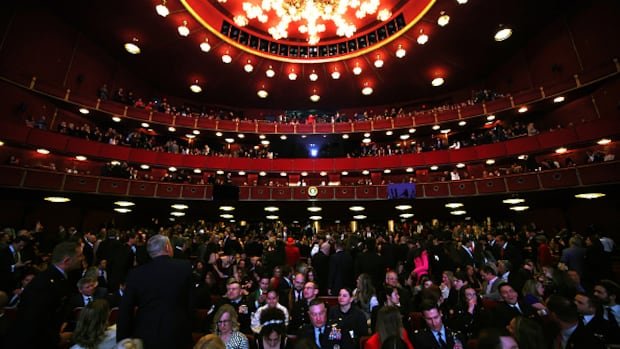

President Donald Trump announced on Sunday his intention to close the Kennedy Center in Washington for a two-year renovation starting in July. This decision comes after a series of cancellations at the venue following Trump’s changes to the leadership and branding of the center. The plan, subject to approval by the Kennedy Center’s board, aims to revamp the facility into a premier hub for arts and entertainment, as stated by Trump in a social media post.
The move to temporarily shut down the center has drawn mixed reactions, with some questioning the necessity of the closure. Despite claims by Trump and Kennedy Center president Ric Grenell about the building’s condition, no concrete evidence has been provided to support their assertions. Grenell emphasized the need for the renovation, stating that the temporary closure would expedite the process and lead to a more comprehensive restoration.
Originally established as a national cultural center, the Kennedy Center was renamed in honor of President John F. Kennedy in 1964. Since its opening in 1971, it has been a prominent venue for showcasing the arts, including hosting the National Symphony Orchestra.
‘Total disregard for Congress’
Several performing arts groups have opted out of performances at the Kennedy Center in response to the recent changes, with composer Philip Glass notably withdrawing his Symphony No. 15 Lincoln. The Washington National Opera also announced plans to relocate its performances from the center, marking another significant departure in the wake of Trump’s involvement.
The reshuffling at the center has not been without controversy, as key personnel departures and disagreements over the direction of the institution have emerged. Critics, including lawmakers like Rep. Joyce Beatty, have raised concerns over Trump’s unilateral decisions regarding the Kennedy Center’s future.
Trump’s initiatives to revamp various landmarks in Washington, including the Kennedy Center, have sparked debates and legal challenges. The president’s ambitious renovation projects have faced pushback from Congress and the public, reflecting broader tensions over the administration’s approach to cultural institutions.