
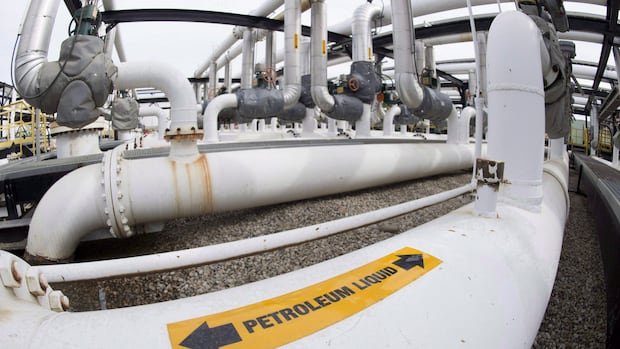

A little over a year since the completion of the Trans Mountain expansion oil pipeline, the Crown corporation is exploring two different approaches to enhance oil export capabilities. This initiative is in response to the pipeline currently not operating at full capacity.
The $34 billion expansion project, which commenced transporting oil from Edmonton to the Vancouver area in May 2024, is currently functioning at approximately 80-85% capacity as confirmed by Trans Mountain officials. Originally, plans to assess potential increases to the pipeline were slated for around 2028, but due to the increasing oil production in Alberta, this timeline has been expedited.
Although the physical dimensions of the pipeline will remain unchanged, the Crown corporation is investigating the utilization of drag reducing agents to boost oil transportation capacity. Additionally, a separate project aims to enhance pumping stations to facilitate increased oil flow through the pipeline.
According to Todd Stack, Trans Mountain’s chief financial officer, the implementation of drag reducing agents, which are cost-effective chemicals, is expected to lead to a 5-10% capacity increase, equivalent to about 50,000-85,000 extra barrels of oil per day. Conversely, enhancing pumping capabilities would be a pricier and lengthier endeavor, with estimated costs ranging from $3 billion to $4 billion. The corporation intends to delve into the optimization project over the next year before making a final investment decision, followed by a construction period spanning several years.
Stack expressed confidence in funding the optimization project, suggesting that profits from existing operations or potential debt could cover the costs. Approval from the federal government is necessary for the projects to proceed, as outlined by Stack.
The expanded Trans Mountain pipeline currently has a total capacity of 890,000 barrels and is anticipated to return $1.25 billion to Ottawa through interest, fees, and dividends by the end of the year. Stack noted the smooth operation of the Trans Mountain expansion, describing it as functioning “spectacularly well.”
At the export terminal in Burnaby, B.C., designed for 34 tankers monthly, the actual operation currently accommodates around 23 vessels per month, loaded to only 70% capacity due to the Burrard Inlet’s depth. The Vancouver Fraser Port Authority has initiated preliminary work to dredge the inlet to support fully loaded oil tankers.
The escalating oilsands industry in northern Alberta is propelling oil production growth, slated to achieve record levels this year with a projected 5% increase in 2025 compared to the previous year. While no major oilsands facilities are under construction, numerous smaller expansions and enhancements by various companies, including Cenovus, Suncor, and others, are in progress over the next five years.
RBN Energy, an energy markets consultancy, warns of potential oil export constraints from Western Canada by mid-2027 without pipeline optimization projects. Enbridge and South Bow, operators of the Keystone system, are exploring methods to export oil using existing infrastructure. Stack is optimistic that with proposed improvements by Trans Mountain and other pipeline companies, Western Canada will have sufficient oil export capacity for the next five years, asserting that the region is secure until 2030 based on projections.