
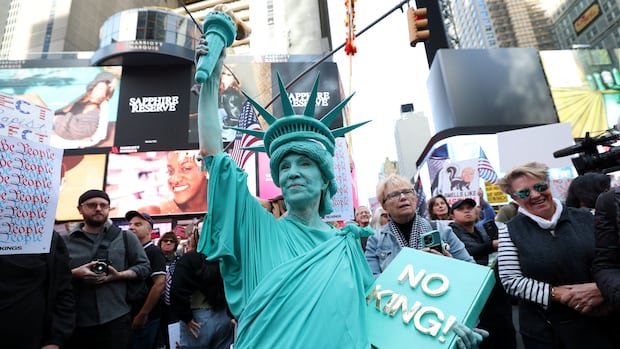

Thousands of individuals gathered across the U.S. on Saturday for “No Kings” protests, expressing discontent with the current U.S. administration under President Donald Trump. These demonstrations, labeled as “Hate America” rallies by the Republican Party, marked the third major mobilization since Trump’s reentry to the White House earlier this year. The protests coincided with a government shutdown, causing the closure of federal services and programs and highlighting the power struggle between the executive branch, Congress, and the judiciary.
Protesters voiced their frustration over criticisms of their intentions, emphasizing the patriotic nature of their dissent. In various locations like Bethesda, Md., and Washington, D.C., participants carried signs advocating for the right to protest and displayed American flags. Trump, who was absent from Washington at the time, refuted claims of authoritarianism in a Fox News interview before heading to a fundraising event in Florida.
Over 2,600 rallies were scheduled nationwide on Saturday, organized by numerous coalition partners. Unlike previous protests this year, which targeted issues like government austerity measures and military displays, organizers described this event as a more cohesive opposition movement. Prominent Democrats such as Chuck Schumer and Bernie Sanders joined the demonstrations, portraying them as a necessary response to perceived threats to democracy by the current administration.
Globally, solidarity rallies occurred in cities including Montreal, emphasizing the importance of defending democracy against perceived threats. The participation in these protests drew criticism from Republicans, who labeled the protesters as extremists and blamed them for prolonging the government shutdown. Democrats, on the other hand, saw the shutdown as an opportunity to challenge Trump’s policies and assert the role of Congress as an equal branch of government.
The evolving political landscape reflects a shift in Democratic strategy, with a newfound determination to confront the administration’s actions and policies. The increased unity and resilience among protesters signal a growing opposition movement against perceived authoritarian tendencies in the U.S. leadership.