
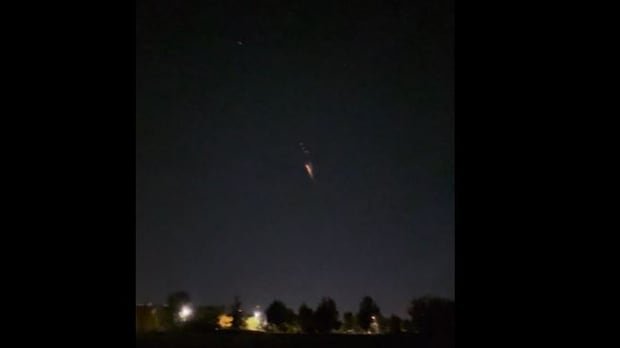

Cody Koloski gazed at the sky on Monday night, eager to catch a glimpse of the northern lights above Saskatoon. The aurora borealis display began to intensify close to midnight but was suddenly disrupted by an unusual sight in the sky. Koloski observed a bright light approaching from the west, initially finding it intriguing but then growing concerned about the possibility of a larger event such as a meteor strike. The light then fragmented into spinning pieces, leaving behind a trail resembling orange embers as it streaked across the sky. The phenomenon quickly subsided as the lights faded away while moving eastward.
This extraordinary occurrence, captured by Koloski’s friend Justin Tan, was shared online in a Saskatoon Reddit forum, sparking discussions among intrigued viewers in Saskatoon and Calgary. The event turned out to be the re-entry of space debris from a SpaceX Starlink satellite, according to Samantha Lawler, an astronomy professor at the University of Regina, who studies satellite impacts on the night sky.
Lawler explained that the space debris seen by Koloski was likely from Starlink #1,066, one of over 8,000 Ford F-150-sized Starlink satellites currently orbiting Earth. When these satellites reach the end of their five-year lifespan, they descend back to Earth, burning up in the atmosphere and potentially leaving behind metals. While the long-term effects remain uncertain, Lawler emphasized the importance of monitoring and reporting any debris sightings to aid research efforts.
Lawler called for residents to remain vigilant for evidence of space debris, emphasizing the significance of public contributions in understanding the impacts of megaconstellations like Starlink on the environment. She encouraged the sharing of videos documenting such occurrences to assist in tracking debris movement and potential landing sites. The professor also highlighted the increasing likelihood of spotting satellite re-entries in Saskatchewan due to Starlink’s orbit patterns.
Despite the spectacle, Lawler reassured the public that the risk of being struck by space debris is minimal at an individual level. However, she raised concerns about current satellite disposal practices and urged for more sustainable approaches in satellite operations, stressing the need for longer-lasting satellites and reduced satellite numbers to mitigate environmental impacts.
Lawler’s research underscores the growing presence of satellites in our skies and the need for responsible satellite deployment strategies to minimize space debris and its implications on Earth.