
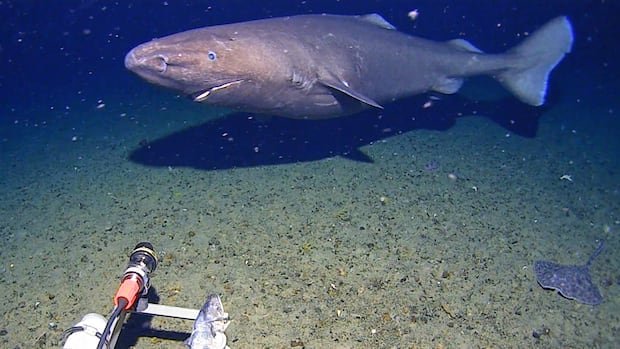

An unusual sight greeted researchers as a large shark, resembling a barrel, glided slowly across a desolate seabed in the deep, sun-deprived waters of Antarctica. This surprising encounter contradicted the belief held by many experts that sharks were not present in the icy Antarctic region. The shark, estimated to be between three and four meters long, was captured on video in January 2025 by a camera operated by the Minderoo-UWA Deep-Sea Research Centre near the Antarctic Peninsula.
Alan Jamieson, a researcher, expressed astonishment at the unexpected sighting, stating that the prevailing assumption was that sharks did not inhabit Antarctic waters. The footage revealed a robust shark, defying expectations with its substantial size. The shark was spotted at a depth of 490 meters, where the water temperature hovered around a frigid 1.27 degrees Celsius.
The presence of the shark was a rare discovery, with no previous records of sharks being found in the Antarctic Ocean. The video footage also showed a skate, a relative of sharks resembling a stingray, unperturbed by the passing predator. This observation was not surprising to scientists, as they were aware of the skate’s range extending to the southernmost regions.
Experts suggested that climate change and warming oceans might be prompting sharks to venture into the colder waters of the Southern Hemisphere, although limited data exists on range shifts near Antarctica due to the region’s remoteness. The sluggish sleeper sharks, known for their elusive nature, could have been residing in Antarctica unnoticed for a long time.
The unique footage of the shark in the Antarctic Ocean highlighted the importance of ongoing research efforts in the region. Researchers emphasized the significance of the discovery and the challenges of studying the sparse sleeper shark population in the Antarctic waters. The shark’s behavior, maintaining a specific depth along the seabed, indicated a strategic positioning to access the warmest layer of water where marine carcasses accumulate.
The Antarctic Ocean’s complex layering, extending to depths of around 1,000 meters, creates a dynamic environment where different water properties interact. This stratification influences the distribution of marine life, with sharks likely feeding on organic matter sinking to the seabed. Research cameras positioned at specific depths in Antarctic waters are limited and primarily operational during the summer months, leading to occasional surprises like the recent shark sighting.
In conclusion, the discovery of the shark in the Antarctic Ocean shed light on the region’s unique marine ecosystem and underscored the need for continued exploration and monitoring efforts in this remote and challenging environment.