

Oil prices increased and global stock markets declined on Wednesday following U.S. President Donald Trump’s comments casting doubt on the temporary ceasefire with Iran. The S&P 500 dropped 0.3% after falling as much as 1.1% earlier in the day, while the Dow Jones Industrial Average fell 1.1% after Trump’s statement signaling the end of the pause in fighting. Despite initial losses, the Nasdaq composite managed to recover and rose 0.2% after Trump clarified that recent hostilities did not signify a return to full-scale war.
Canada’s primary index, the S&P/TSX, closed the day down approximately 1%. Meanwhile, in the oil market, the price of Brent crude surged by 5.2% to $78.02 US shortly after 4 p.m. ET, briefly surpassing $80 US. Although still lower than its previous peak during the conflict, the sudden increase is concerning given that oil prices had recently stabilized prior to the escalation.
Concerns persist that a prolonged conflict could disrupt the flow of oil through the Strait of Hormuz, potentially leading to supply shortages and impacting global inflation. This scenario could prompt central banks to raise interest rates to counter inflation, albeit at the expense of economic growth and investment returns.
On Wall Street, companies heavily reliant on fuel experienced significant declines, with American Airlines losing 4% and cruise operator Carnival dropping by 3.9%. Housing industry stocks also suffered, attributed to fears of rising Treasury yields affecting mortgage rates and dampening demand in the sector.
Conversely, certain influential artificial intelligence stocks saw a resurgence, offsetting some losses. Notably, Nvidia saw a 3.7% increase, exerting a positive influence on the S&P 500 due to its status as one of the largest stocks in the market.
In the bond market, Treasury yields rose alongside oil prices, with the 10-year Treasury yield reaching 4.57%, up from 4.55% the previous day and significantly higher than pre-conflict levels.
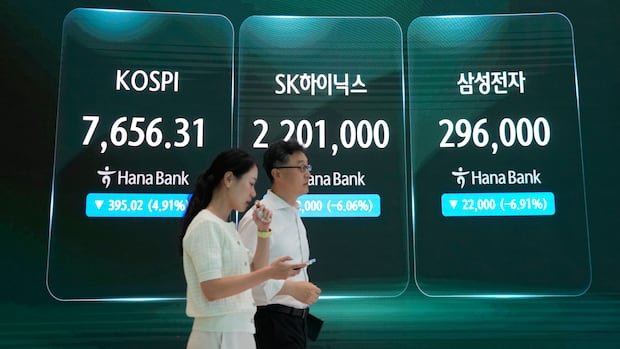
Internationally, European markets experienced heightened losses post-Trump’s ceasefire remarks, with Germany’s DAX and France’s CAC 40 both declining by 2.2%. South Korea’s Kospi witnessed a 5.3% drop amid fluctuations driven by AI stock concerns, while Hong Kong’s Hang Seng index defied the trend, rising by 3%.
Chinese AI startup Zhipu’s shares in Hong Kong surged by 13.4%, following a remarkable 1,300% increase since its trading debut in January. The company’s positive performance follows the expiration of a six-month lockup period for key investors.
Overall, market volatility persists amidst geopolitical tensions and economic uncertainties, underscoring the intricate interplay between global events and financial outcomes.