

Adriana Avelina Ruíz Márquez utilizes adhesive typically used for fake eyelashes to affix a small transmitter just behind the head of monarch butterflies on their thorax. These butterflies, weighing approximately half a gram, effortlessly carry the 60-milligram device, equipped with a solar panel the size of a grain of rice. Following the delicate procedure, which involves a toothpick and a Q-Tip, Ruíz Márquez releases the butterflies, allowing them to swiftly take flight by flapping their wings.
The innovative tracking device, a first-time application in Mexico to label monarchs before their migration to the U.S. and southern Canada, is expected to unravel some mysteries surrounding these insects. Ruíz Márquez expressed optimism that leveraging people’s smartphones will aid in monitoring the butterflies’ movements and shedding light on aspects such as their migration route and behavior upon arrival and departure.
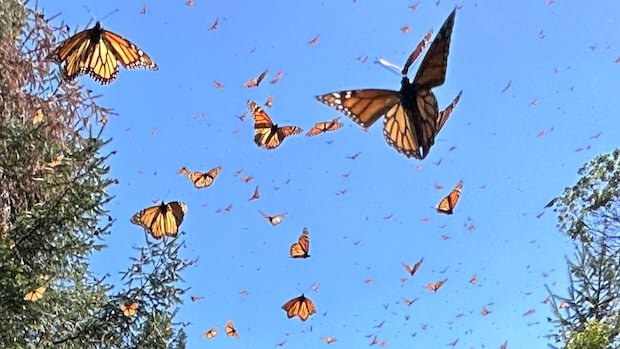
Amidst the scenic El Rosario butterfly sanctuary, where butterflies swirl in abundance akin to mosquitos and blackflies in Canadian marshlands during dusks, the majority of North America’s eastern monarchs overwinter. Situated in Michoacán, about 180 kilometers west of Mexico City, El Rosario is one of the six sanctuaries constituting the Monarch Butterfly Biosphere Reserve, spanning Michoacán and the State of Mexico, with a core protected area of approximately 135 square kilometers.
Teams from the federal Commission for National Natural Protected Areas and World Wildlife Fund (WWF) Mexico have tagged a total of 160 monarchs across the reserve, with 40 in El Rosario, using the new transmitters. This initiative, spearheaded by biologist Eduardo Rendón Salinas from WWF Mexico, aims to offer unprecedented insights into the initial stage of the monarchs’ northward migration.
The monarch butterflies embark on a journey spanning up to 5,000 kilometers, completed by three to four successive generations. Notably, a distinct “super generation” of monarchs, emerging from regions like the Prairies to the Maritimes and through the U.S. Northeast and Midwest, traverses the southward migration in a single trip. These monarchs mate in sanctuaries like El Rosario before embarking on their northward journey again, laying eggs for the next generation en route.
The novel microchipped transmitters emit signals detectable by nearby iPhones, enabling the crowd-sourcing of the butterflies’ trajectory. Through the Project Monarch app or a handheld receiver, individuals can contribute to tracking the butterflies by turning on Bluetooth and location functions on their devices. This technological advancement, developed by Cellular Tracking Technologies based in New Jersey, provides a level of spatial detail previously unattainable by merely relying on wing tags affixed to monarchs.
The ongoing developments with the transmitters, including plans for Android smartphone compatibility as passive detectors, signify a significant leap in understanding the movements and behaviors of monarch butterflies during their migration. These advancements are crucial in enhancing scientific knowledge and conservation efforts aimed at supporting the monarch butterfly populations across their vast migratory range.