
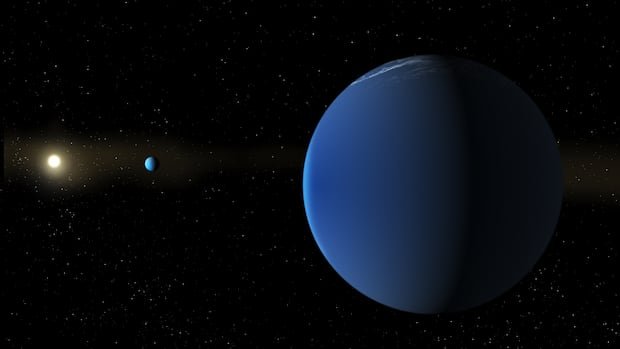


Approximately 1,113 light years away from our planet, there are two planets orbiting a single star, resembling Jupiter in size but having a density akin to cotton candy.
These recently identified exoplanets are categorized as “super-puffs” due to their remarkably low density.
Lead author of the study on these peculiar planets, University of Oxford astrophysicist George Dransfield, likens them to “a nice blob of shaving foam, fresh from the can.”
So, how does a fluffy celestial mass evolve into a planet 1,000 times larger than Earth?
“We currently do not have a definitive answer,” explained co-author Antoine Petit, a mathematician at France’s Centre National de la Recherche Scientifique, in a conversation with As It Happens host Nil Koksal.
“There is a significant amount of theoretical research required to comprehend how these planets can maintain such substantial size.”
The study was officially released in the Monthly Notices of the Royal Astronomical Society on Thursday.
What defines a super-puff?
Super-puff planets are believed to be relatively scarce in the universe. NASA has confirmed nearly 6,300 exoplanets outside our solar system, with fewer than 40 falling under the super-puff classification.
“The presence of two super-puffs orbiting the same star makes this discovery especially intriguing,” remarked Lisa Dang, an astrophysicist at the University of Waterloo in Ontario.
These planets pose a mystery as planets with greater mass generally exhibit higher density, not necessarily larger size.
“Typically, as they gain mass, the planet’s gravity causes it to contract,” explained Dang, who was not part of the research team.
“The discovery of these super-puff planets is remarkable because it implies the existence of an internal mechanism responsible for their expansion.”
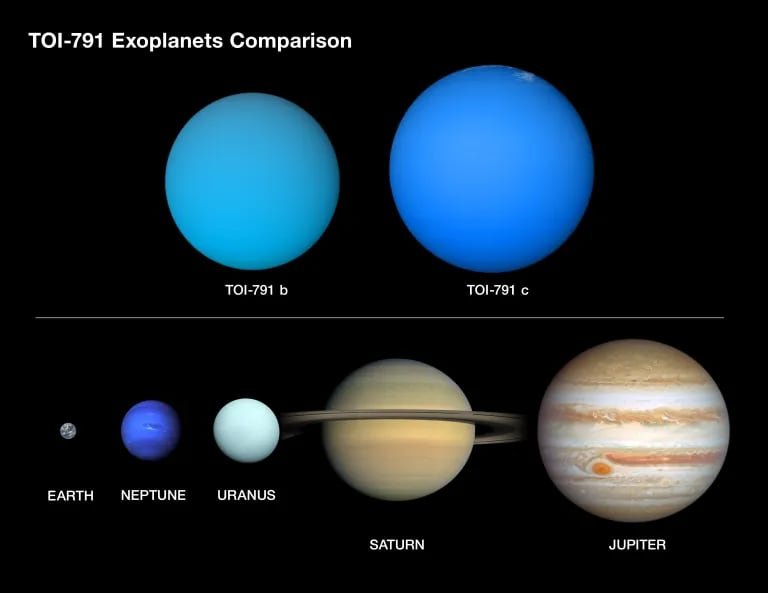
According to Nicolas Cowan, a professor of physics and planetary sciences at McGill University in Montreal, there are two main theories explaining the existence of these massive puffballs — either they are very young or very hot.
“These planets are essentially gas giants, and since gas is compressible, the planet’s size is greatly influenced by its temperature,” stated Cowan, who was not affiliated with the discovery.
“Therefore, a planet composed of the same materials as Jupiter, if heated internally, would expand and increase in size, and