
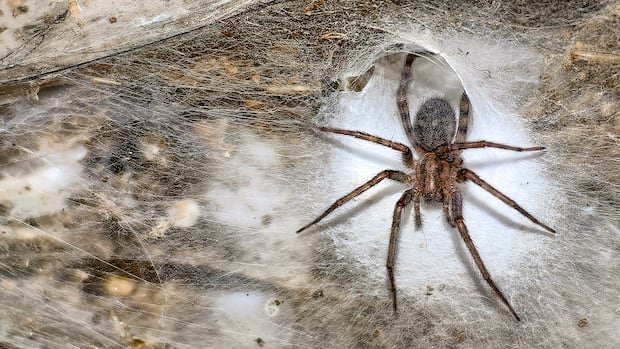

In a surprising discovery, scientist Serban Sarbu and his team encountered a vast ecosystem within Sulfur Cave, situated on the Albania-Greece border. The researchers stumbled upon a massive spider web housing over 111,000 spiders, marking a unique find in the cave’s otherwise lifeless environment.
The recent revelation, detailed in the Subterranean Biology journal, challenges the conventional belief that caves lack substantial biodiversity due to the absence of light for photosynthesis. Typically, cave-dwelling creatures are small, blind, and sluggish to conserve energy in such environments.
The thriving spider population in Sulfur Cave thrives due to the sulfur-rich conditions within. Microbes utilize the chemical energy produced from hydrogen sulfide oxidation, supporting a variety of organisms like centipedes, scorpions, beetles, bats, and chironomid fly larvae.
Interestingly, the coexistence of two spider species, Tegenaria domestica and Prinerigone vagans, within the colossal web is a noteworthy phenomenon. Evolutionary biologist Lena Grinsted highlighted this peaceful cohabitation as uncommon, as larger spiders typically prey on smaller ones. The spiders’ vision impairment in darkness might explain their reduced aggression and potential cooperation in web-building.
Despite public fascination with the spider discovery, Sarbu expressed surprise at the widespread interest, considering the typical aversion to spiders. The massive, intricate web spanning 1,140 square feet in the cave’s narrow passageway continues to captivate researchers and the public alike.