
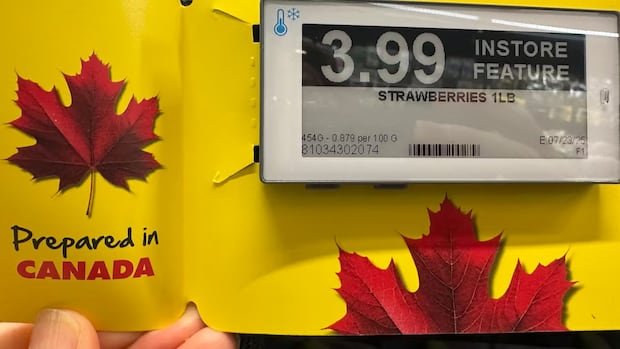

Canada’s food regulator has imposed a $10,000 penalty on a Loblaw-owned store for wrongly promoting imported food as a “Product of Canada.” The Canadian Food Inspection Agency (CFIA) informed CBC News that a Toronto Superstore utilized “maple leaf advertising decals” in an in-store exhibit to endorse a foreign product, leading to a deceptive product advertisement about its origin.
The CFIA, which can levy fines of up to $15,000 for each violation, issued the fine on Jan. 15. However, the agency delayed the announcement until this week. Neither the federal agency nor Loblaw disclosed the specific product that triggered the penalty.
The Superstore, situated on Gerry Fitzgerald Drive in the city’s north end, stated that accurately displaying country-of-origin information is complex due to managing extensive inventory. Loblaw expressed regret for any confusion caused, emphasizing ongoing efforts to enhance their procedures.
The surge in the buy-Canadian movement, spurred by U.S. President Donald Trump’s tariff disputes and remarks about Canada potentially becoming the 51st state, prompted grocers to capitalize on the trend by leveraging Canadian branding for local products, sometimes inaccurately.
Following a CBC News investigation last summer, which exposed major grocers promoting imported food as Canadian through “maple washing,” the CFIA’s decision to penalize the Superstore underscores the importance of accurate food labeling and signage.
Instances of inaccuracy included a Toronto Sobeys advertising almonds with a red maple leaf symbol and a “Made in Canada” claim despite Canada not producing almonds. Similarly, a Loblaw-owned Toronto No Frills displayed strawberries with misleading signage implying Canadian origin while the packaging indicated they were a “product of USA.”
Shoppers had voiced discontent last September over the CFIA’s delay in penalizing grocers for “maple washing” despite the agency’s own discoveries. The CFIA, emphasizing its commitment to combat food mislabeling, considers various factors in determining enforcement actions.
The agency is yet to respond to inquiries regarding Sobeys’ avoidance of fines after a mislabeling incident last April involving Compliments avocado oil. Sheila Young, who reported the avocado oil mislabeling, urged the CFIA to enforce fines in such cases, emphasizing the need for prompt regulatory action.
According to the CFIA, “Product of Canada” signifies food entirely or nearly entirely made in the country, while “Made in Canada” requires the last significant transformation of a food product to occur domestically.