
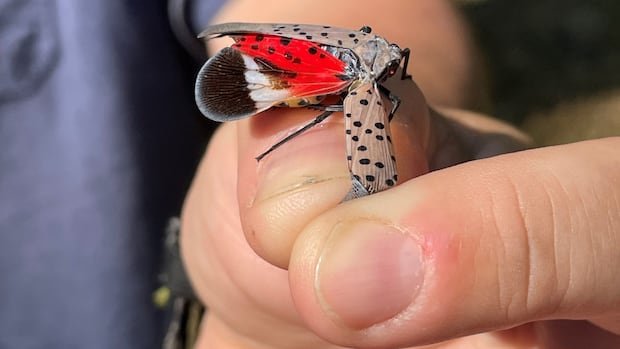

Research conducted at the Great Lakes Forestry Centre in Sault Ste. Marie, Ontario, has identified a concerning discovery about an invasive insect inching closer to the Canadian border. Amanda Roe, a research scientist with Natural Resources Canada based at the forestry centre, revealed that the spotted lanternfly, especially their eggs, can endure extremely cold temperatures, with recent studies showing their survival at temperatures as low as -25 degrees Celsius. This resilience suggests that winter conditions may not be sufficient to halt the spread of this destructive pest into parts of Canada.
The spotted lanternfly, originating from Asia, is a destructive sap-sucking insect that pierces trees and plants with straw-like mouthparts to extract sap. First detected in the United States in 2014, the insect has rapidly expanded across the eastern U.S., establishing populations in at least 19 states, including Michigan and New York, as well as communities along Lake Erie.
The impact of the spotted lanternfly extends to more than 100 plant species, according to Olivier Morin, a plant health survey biologist at the Canadian Food Inspection Agency. While various plants may be affected, grape production is expected to bear the brunt of the damage. Infested areas in the U.S. have already experienced significant issues in vineyards and agriculture due to reduced yields and weakened crops caused by the insect’s feeding habits. Moreover, the production of honeydew by these insects encourages mold growth and coats surfaces, posing a threat to agricultural operations.
Amanda Roe emphasized the significance of the spotted lanternfly’s impact on commodities vital to many regions of Canada, noting their affinity for plants like maple trees, which raises concerns for the maple syrup industry. The Ontario Maple Syrup Association has been monitoring the insect to assess potential risks to maple syrup production.
Although studies shed light on the insect’s ability to tolerate cold climates, Roe cautioned that invasive species can adapt to new environments over time. Morin highlighted the role of human activity in the insect’s spread, describing the spotted lanternfly as an adept hitchhiker that can travel long distances by attaching to vehicles, cargo, and outdoor equipment. The Canadian Food Inspection Agency has intercepted spotted lanternflies on various shipments and vehicles arriving from the U.S., signaling the imminent threat of the insect’s establishment in Canada.
Morin urged individuals encountering spotted lanternflies to document and report sightings to the Canadian Food Inspection Agency, emphasizing the need to impede the insect’s spread and mitigate its potential impacts in Canada.