
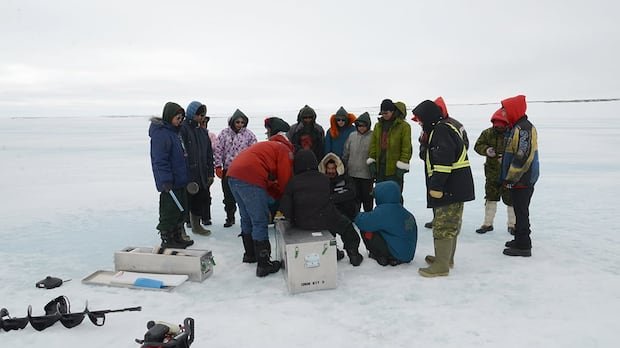

Candice Sudlovenick finds fulfillment in her role as an outreach programs manager at SIKU. She first engaged with Ikaarvik as a young person more than ten years ago and attributes her passion for research to that experience. Describing her time with Ikaarvik as empowering, Sudlovenick highlighted the importance of realizing her own voice and the willingness of others to listen.
A recent article in Arctic Science, co-authored by Danielle Nowosad, a postdoctoral fellow at the University of Calgary of Métis descent, delves into the methods of Inuit leadership in research. Nowosad emphasized the growing efforts in Canada to incorporate Indigenous perspectives and knowledge into research practices.
Ikaarvik originated from the initiative of a group of Inuit youth who graduated from the Environmental Technology Program at Nunavut Arctic College in Pond Inlet in 2010. Their goal was to extend their environmental work beyond the classroom setting. The organization aims to transform obstacles into opportunities by preparing Inuit youth for careers that bridge traditional Inuit knowledge with scientific research.
Sudlovenick highlighted the shift in research dynamics, noting the historical challenges in community-research relationships. She emphasized that Ikaarvik advocates for recognizing Inuit contributions beyond traditional roles like camp cooks or bear guards. Nowosad echoed the sentiment, pointing out the long-standing efforts of Inuit communities to have a more substantial role in research processes.
While acknowledging the differences between Western science and Inuit Qaujimajatuqangit (IQ), which refers to traditional knowledge, Nowosad emphasized the shared rigor between the two. She emphasized the depth of respect inherent in IQ, contrasting it with potential shortcomings in Western scientific practices.
Despite improvements in collaborative efforts, Nowosad and Sudlovenick highlighted persistent challenges in research partnerships. They pointed out discrepancies in timelines and priorities between academic institutions and community-based work. While recognizing the evolving recognition of the strength of community-engaged research, they noted the need for more alignment between funding systems and the realities of relationship-focused research.
With the increasing urgency of climate change in the Arctic, both researchers and community leaders stress the growing significance of local knowledge. Sudlovenick underscored the importance of valuing Indigenous knowledge on par with Western science to empower youth in northern regions. She expressed optimism about the potential for collaboration between technology and traditional knowledge to bridge divides in research approaches.
As the next generation incorporates both modern technology and traditional wisdom, the dichotomy between Western science and Inuit Qaujimajatuqangit may continue to blur, paving the way for a more integrated approach to Arctic research.