
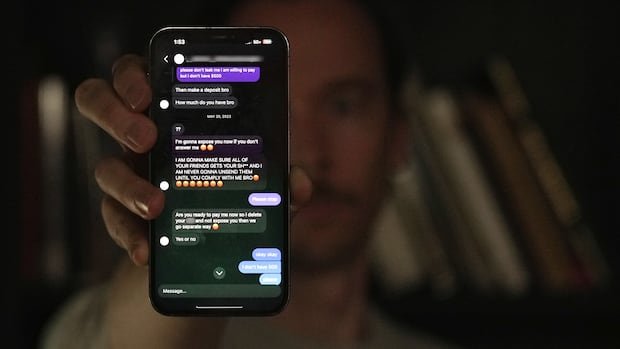

Warning: This article discusses suicide.
“John,” a self-proclaimed scammer, dedicates his time to enticing foreigners to send him money.
In an interview with CBC’s Marketplace, John disclosed his modus operandi of targeting individuals on social media platforms like Facebook and Instagram, particularly focusing on accounts of celebrities and their followers before initiating contact.
Hailing from Lagos, Nigeria, John, a member of the “Yahoo Boys” group, engages in various scams, including coercing teenagers into sharing compromising photos which are later used for monetary blackmail.
To shed light on the operations of such scammers, John, not his real name, shared insights with Marketplace under the condition of anonymity.
-
For the full investigation, watch ‘The Sextortion Network’ on Friday at 8 p.m. (8:30 in N.L.) on YouTube, CBC TV and CBC Gem.
Since 2021, there has been a surge in sextortion cases in Canada, with over 40 documented suicides in North America, Australia, and the U.K. linked to this form of exploitation, including five in Canada.
Paul Raffile, a specialist in sextortion and cybercrime from Connecticut, expressed strong condemnation for this type of scam, labeling it as one of the most abhorrent due to its exploitation of children and manipulation for financial gain.

Despite the despicable nature of sextortion, scammers like the Yahoo Boys proudly display their wealth on social media, showcasing extravagant lifestyles and exchanging tips on platforms like WhatsApp and Telegram to enhance their extortion techniques, which include manuals, scripts, and apps aimed at maximizing their financial gains.
When questioned by Marketplace about the repercussions faced by their victims, John appeared indifferent, reflecting the callousness prevalent in such criminal activities.
Raffile lamented the continued prevalence of this crime, emphasizing the importance of preventive measures to combat sextortion effectively.
‘He had such a big heart’
The tragic reality of sextortion hit close to home for Ryan Cleland, whose son, Carson, fell victim to the exploitative scheme.
Carson, a 12-year-old, was ensnared by a scammer on Snapchat who manipulated him into sharing explicit images, leading to subsequent blackmail attempts. Sadly, Carson succumbed to the pressure and tragically took his own life.

Recalling Carson’s vibrant personality, Cleland described his son as a joyous and lively child whose untimely death left a void in their family.
Recent data from the Canadian Centre for Child Protection reveals that a majority of sextortion victims, 85%, are male, underscoring the