
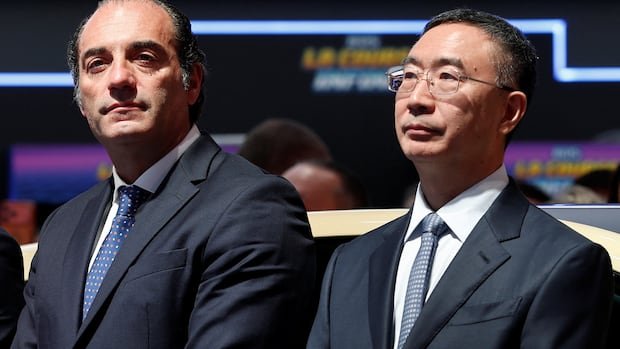

Stellantis and Volkswagen, key players in Europe’s automotive industry, showcased their confidence in electric vehicles at the Paris auto show, drawing inspiration from Chinese competitors and partners who are reshaping their domestic market.
Both companies are revamping their strategies to tackle the increasing competition posed by Chinese rivals in Europe. Stellantis, which encompasses popular brands like Citroen, Peugeot, Opel, and Fiat, is leveraging its partnerships with Leapmotor and Dongfeng to delve into the Chinese market’s technological advancements, as revealed by CEO Antonio Filosa.
Filosa emphasized the importance of collaboration and knowledge sharing between the companies to enhance their capabilities and competitiveness in the evolving automotive landscape. Stellantis recently forged production alliances with Leapmotor and plans to engage with Dongfeng, aligning with the shift towards localized manufacturing to meet European standards.
The surge in electric vehicle adoption in Europe, driven by factors like fuel price hikes and the availability of affordable models, has spurred both Volkswagen and Stellantis to fortify their market positions against Chinese rivals expanding globally. The transition to electric vehicles has been particularly notable in countries like Italy and Spain, where electric vehicle adoption is on the rise.
Stellantis’ collaboration with Leapmotor has yielded a joint project involving a mid-sized electric SUV developed in partnership with Opel, showcasing the speed and efficiency of the cooperation. While Stellantis unveiled several concept vehicles in Paris to revamp its lineup, industry experts like Felipe Munoz stress the urgency for the company to focus on production rather than concepts to keep up with the rapidly evolving market.
Volkswagen’s transformation has also been influenced by China, with CEO Oliver Blume likening the country to a “fitness center” for the industry. However, the impact on Volkswagen’s European operations has been limited, with partnerships like Xpeng primarily targeting the Chinese market. Blume mentioned the absence of a current need for a Chinese joint venture in Europe, highlighting Volkswagen’s self-sufficiency in China.
Analysts like Stefan Bratzel note that both Volkswagen and Stellantis are engaging with Chinese entities in distinct ways, with Stellantis’ collaboration with Leapmotor proving to be successful in Europe. Acknowledging China’s evolving role, European automakers are embracing the opportunity to learn and adapt from their Chinese counterparts, signifying a reversal in the traditional learning dynamic between the two regions.