
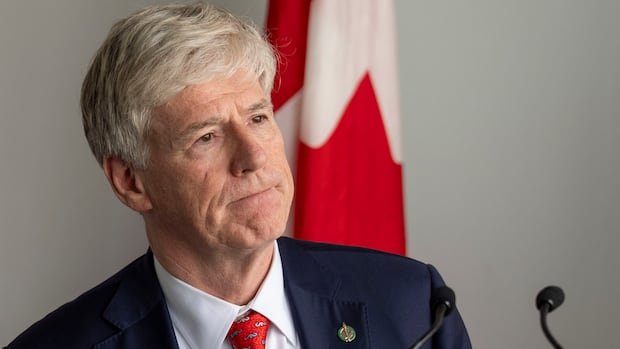

In anticipation of Prime Minister Mark Carney’s climate competitiveness strategy release, Energy Minister Tim Hodgson provided insights into the upcoming budget announcement.
Before meetings with G7 environment and energy ministers, Hodgson discussed key elements that are expected to be part of the strategy.
There was an expectation among stakeholders in the environmental and clean tech sectors that Ottawa would unveil the strategy before the G7 conference, commencing officially in Toronto on Thursday.
While not directly mentioning the climate strategy, Hodgson outlined three approaches guiding the government’s initiatives.
One approach involves strategically utilizing public funds and tax incentives to reduce risks and encourage investments in innovative projects, Hodgson explained.
The objective, according to the minister, is to ensure the Canadian economy remains competitive and Canadian goods excel in a low-carbon environment.
Hodgson indicated that Canada’s expanding carbon capture, storage, and removal sector could benefit from government support to reduce risks and expand its scale.
He highlighted Arca, a Canadian firm that recently partnered with Microsoft to extract carbon dioxide from the atmosphere, with backing from NorthX Climate Tech — a Canadian entity supported by Natural Resources Canada.
Hodgson emphasized Ottawa’s focus on establishing a regulatory framework characterized by predictability, expedited processes, and reliable permits. The government is currently working on implementing legislation to streamline major resource projects.
The minister also highlighted the use of artificial intelligence as a third lever to enhance energy systems’ efficiency, speed, and resilience.
“AI is already revolutionizing energy production, distribution, and consumption,” Hodgson noted. “It aids in real-time grid demand prediction, accelerates material discovery for enhanced batteries, and optimizes renewable energy sources like wind farms.”
Milestone in Emissions Cap Proposal
A senior government source, speaking on condition of anonymity, mentioned that the first two levers — promoting investments in clean technology and ensuring industry certainty — are integral to the climate competitiveness strategy.
Hodgson’s comments did not touch on the future of the industrial emissions capping proposal. The budget release on November 4 marks a year since the government unveiled draft regulations proposing a strict cap on emissions from the oil and gas sector, which accounts for a significant portion of Canada’s emissions.
- <a class="cardWrapper-u5T0r cardWrapper-_487P noPaddingCardWrapper" data-feature-instance="similar-link" data-feature-name="link" data-contentid="1.7372512" aria-hidden="false" data-cy="type-link" href="https://www.cbc.ca/news/politics